Treating Worms in Backyard Chickens.

As the Autumnal Equinix approaches the long days of summer finally retreating, this is a perfect time to consider worming your flock. Chickens, if allowed to free range, will spend most of the “dog days of summer” dining on, bugs, weeds, grass, and other delectables they find scurrying about. Worms are mostly associated with dogs, such as the dreaded heartworm, but chickens can also contract worms as well. Because most backyard chicken flocks have access to green grass, sunshine, fresh air, and bugs, they will most likely pick up worms.

While worms in your flock may be a scary prospect to face, take heart, the fact that your flock needs routine deworming means your ladies are living the good life. Look at deworming your flock as a badge of honor, a testament to the freedom and contact with the outside world that many chickens are denied.

Got Worms?

Knowing that worms are a given in a backyard flock that lives the good life, how it is determined that a flock has worms?

The worms that infect the digestive tract of chickens are large roundworms. They are most often discovered while cleaning the coop or removing the poop from the previous night’s roost. Worms present in chicken dropping will look like fine angel hair spaghetti (I know the word picture is rather discussing, sorry about that). The worms may or may not be moving, however, it will be clear to any keeper that white spaghetti strands found on your coop floor are not a normal occurrence.

If you find worms on the floor of your coops when cleaning, this indicates that not only does your flock have worms but the load within their bodies is escalated. Allow me to explain.

A chicken’s body can handle a worm load within the normal parameters. Chickens evolved to live outdoors in constant contact with these parasites. Their bodies up to a certain point can tolerate a normal worm load in their digestive tract while remaining healthy. It is when this balance becomes compromised that problems arise. One of the indications of problems is finding worms on the floor of your coop when cleaning.

What problems do an unchecked heavy worm load cause?

Chickens with a heavy worm load will succumb to several health issues, the most common is weight loss. If you notice a hen who has begun to look rather skinny despite eating well, she may have a higher-than-normal worm load within her body.

You will also notice chickens with worms will have a dirty vent area, often caused by runny poop which sticks to their vent feathers. Listless is also common in chickens with a heavy worm load. The worms in the digestive tract consume energy from the food they eat. This will leave hens with a heavy worm load weak and often present with an appearance of ill health. A hen who does not move very much or does not leave the coop during the day is most likely weak and suffering from a worm overload.

If the worm load in the hen’s body is allowed to persist keepers can find worms in the eggs. In the end, a heavy worm load will eventually result in the death of the hen. Worms in a flock will need to be addressed.

So how does a keeper deal with worms in their flock?

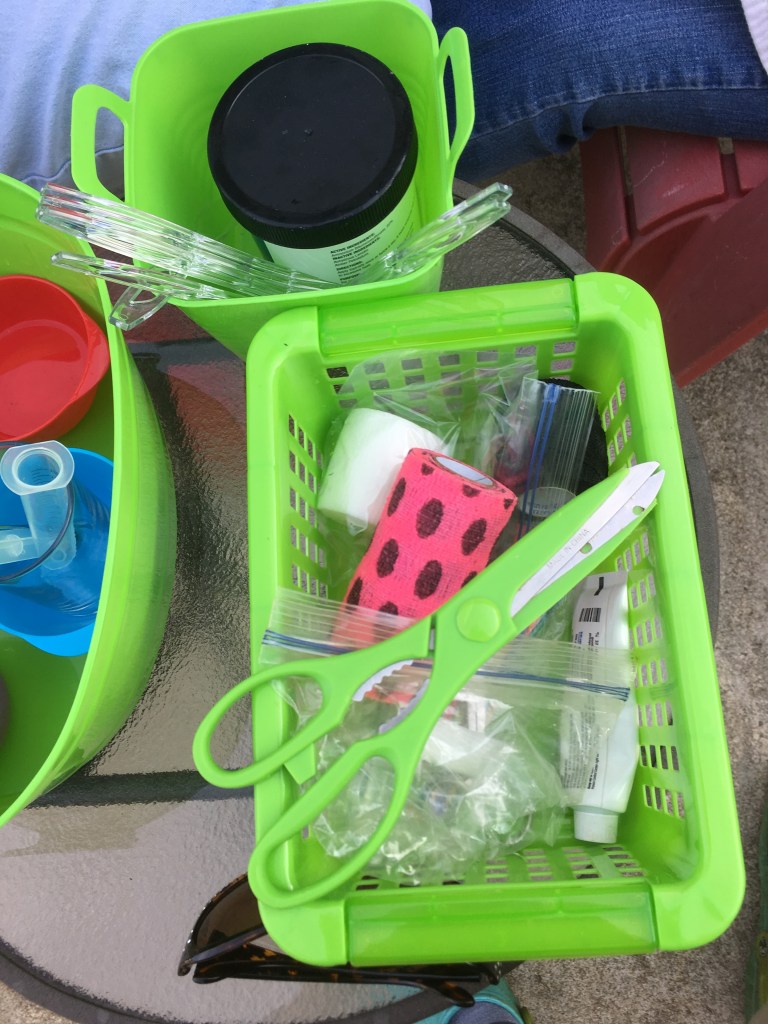
Treating your flock for worms is a very easy and straightforward procedure. To address this issue in your flock you will need several things a dewormer, a syringe with the needle removed, and a partner.

To date, there is no dewormer on the market that is FDA approved for chickens. What this means is that the FDA has not specifically set aside funds and performed a test to determine the effectiveness of dewormers developed specifically for chickens. Do not let this bother you, it is safe to use dewormers produced for other livestock administered at certain doses that are safe for chickens.

**Disclaimer** The following is my methodology for deworming my flock. Keep in mind I am not a professionally trained veterinarian nor am I suggesting that my opinions should replace proper vet care given the situation. I share this information based on my experience in treating worms in my flock throughout the past decade. I do have some resources that validate my methodology.

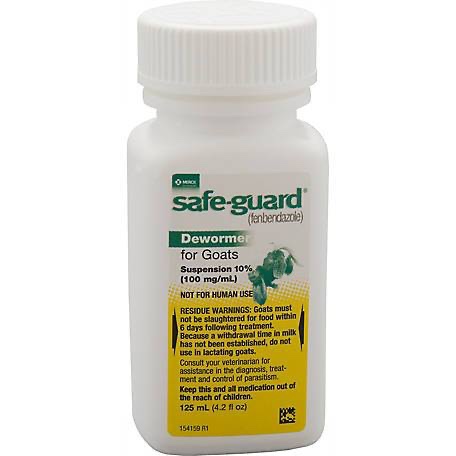
For treating worms in my flock, I use Safeguard dewormer marketed for goats. I like Safeguard because it is a broad-spectrum dewormer. Not only will it treat roundworms in your flock, but it will also treat other worms as well (gape worms, flatworms, lungworms, etc.).

Safe Guard dewormer-available OTC at most farm/feed stores

Safeguard is sold OTC (Over the counter) at most farm/feed stores, it carries an MSRP of about $30-$50 depending on location.

To deworm with Safeguard you will need to orally administer the dewormer to every individual in your flock. This dewormer is NOT mixed in food or water, it has to be administered following a specific dosage directly to the bird.

For Bantam, breeds administer 1/2cc or 1/2 ml. (metric system measurements; I cc converts to 1 ml)

For Standard breeds administer 3/4 cc or 3/4 ml

Safe Guard Dewormer in syringe.

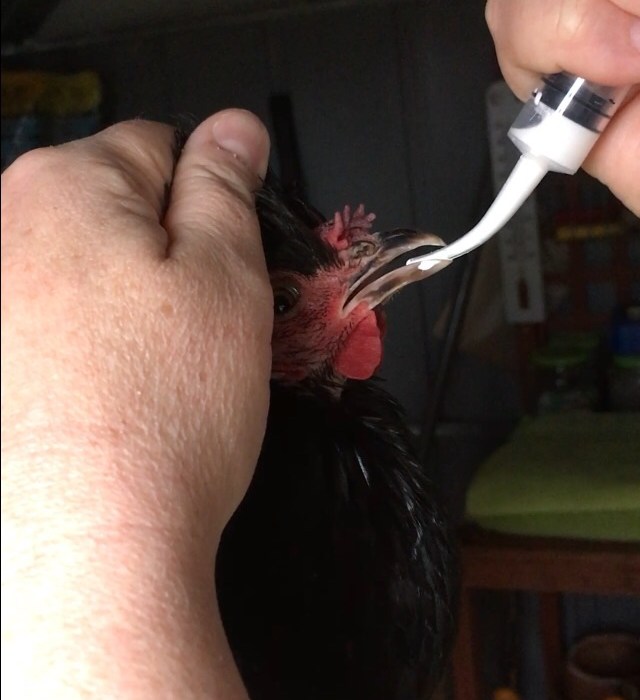
Using the measurement indications on your syringe, measure the correct dosage directly from the bottle (do not dilute) and put it directly into the beak of the chicken. The chicken will need to swallow the dewormer, so if they spit it out, you will need to try again.
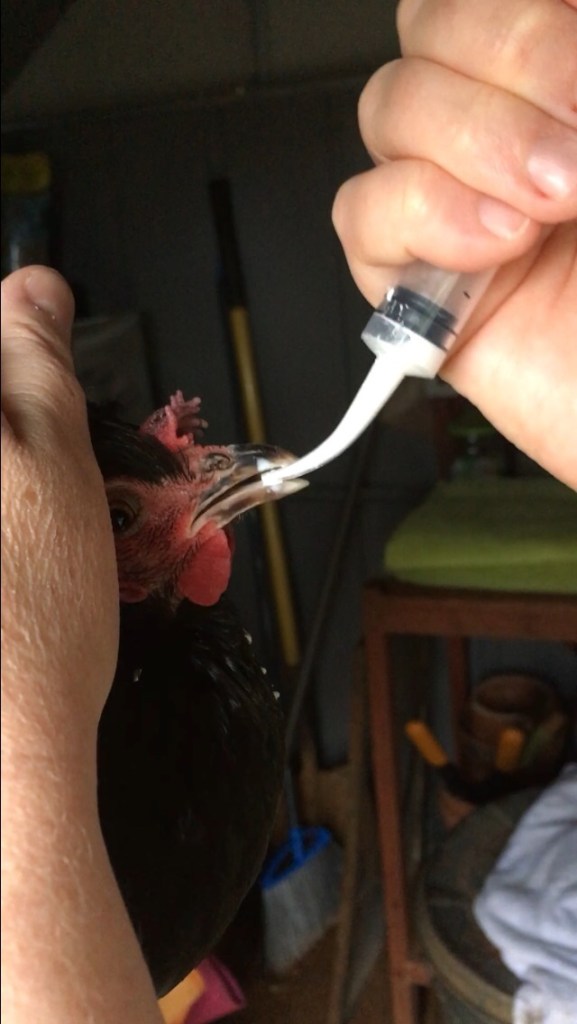
Leah (bantam cochin) orally injesting Safe Guard Dewormer.

I have found through experience that obtaining a syringe with a curved tip is best when orally administering a dewormer to the flock. These syringes are often stocked by dentists and oral surgery offices. When I visit my dentist for my annual cleaning, (in addition to the oral care sample bag) I will ask for some of their curve-tipped syringes for my chickens. They happily oblige my rather strange request.

Once your flock has been dewormed, you will need to administer it again in 10-14 days. The first dose of dewormer will kill all of the live worms that reside in the digestive tract of your birds. The second dose will kill and remove any eggs that may have hatched during the first dosing.

Note: during treatment, you will need to observe a 20–28-day egg withdrawal. Any eggs laid during treatment are not edible for human consumption. In addition to residue from the dewormer, it is possible to get worm fragments in your eggs. If you sell your eggs, advise your customers that you will not be able to sell any eggs till the egg withdrawal period has passed.

Once your flock has completed the deworming treatment process, your flock will be free of worms and your health status should improve.

Another Note: It is not necessary to deworm as a preventative, this does more harm than good. A chicken’s body has evolved to handle a certain worm load without any ill effects on health. Only when you notice an indication of an advanced worm load in your flock do you need to act. If you worm your flock as a preventative, you will reduce the natural ability of your flock to regulate a worm load within set evolutionary parameters.

Think of it like antibacterial soap. If we constantly wash our hands with antibacterial soap, we reduce our body’s natural ability to build immunity to the normal bacteria in our environment. Thus, reducing our body’s natural ability to adapt to the contact of these particular normal microbes. The same is applied to your flock. It may be tempting to act as a preventative but in the end, your flock will incur more harm than benefit.

Only deworm when signs of increased worm load are present in your flock.

Below I will link a video from my YouTube channel demonstrating deworming my flock. This will allow you to see my methodology and process so you can address worms in your flock.

I hope this post has helped you navigate worms and the process of deworming your flock.

I am a published author, multi-disciplinary writer, and blog contributor. If you like my work, please visit some of my other sites.

Knowledge of the Spheres – Exploring the Celestial Spheres!

Coffee and Coelophysis – A blog about dinosaurs.

Chicken Math University – Adventures in Homeschooling

If you like this blog, please peck the subscribe button. As always, thanks for reading. Till next time, keep on crowing!

~ The Kuntry Klucker Crew~

My Favorite Rooster Breeds.

When acquiring a backyard chicken flock, most people opt for a flock of ladies. But for those who want a rooster or two, but are apprehensive as to which breads are best, this post is for you.

My flock total clocks in at around 50-60 birds (according to chicken math), 30-40 or so hens, and 13 roosters. Half of the gents’ free range with the girls, the rest reside in a bachelor pen. A bachelor pen is a coop/pen assigned to house just roosters. There are no hens in a bachelor pen. Contrary to the prevailing opinion, roosters can and do cohabitate well together. However, there are some tricks to successfully house roosters together. To see how I use and manage a bachelor pen, click here.

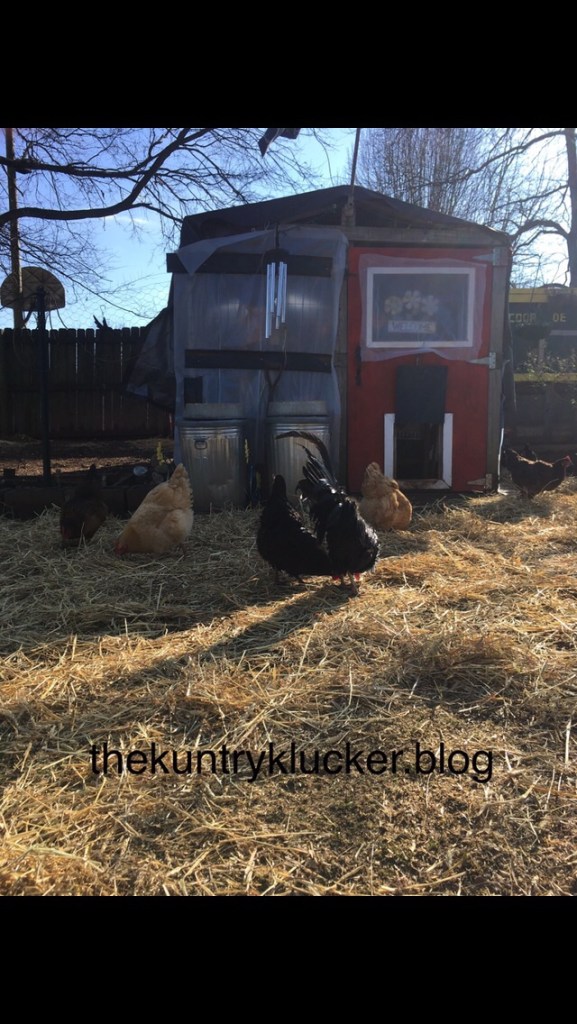
The “coop-hood”.

I have three large coops that house my girls,and within each of these dwellings, I have two roosters. These gents care for and protect the ladies while they are free ranging. That means, on any given day, I have 6 roosters in the yard with the ladies.

The roosters of yesteryear, which star in our nightmares, were often played by the game cock, according to today’s breeding standards. The rooster we met on our grandparents’ farm was very aggressive and for good reason. Our grandparents kept chicken to supply the family with eggs and meat, a defensive rooster was needed. However, many things have changed since our grandparent’s day.

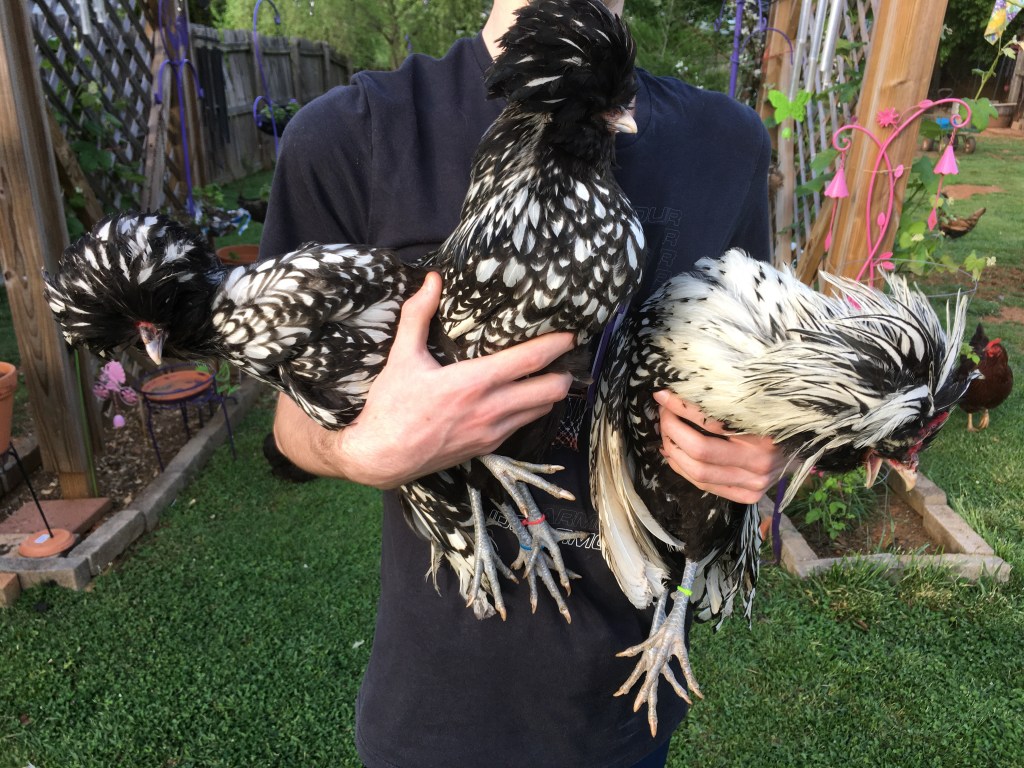
Deaky, Fi, and Freddie (Laced Polish Hens) perching on a hammock swing under the grape arbor.

The backyard chicken hobby has exploded, with chickens replacing the family dog in terms of popularity. Backyard chickens are quickly becoming the go-to for a backyard homestead. In the wake of COVID-19, everyone wants more control over their food supply. Backyard chickens have never been more popular than they are right now. Correspondingly, the breeding industry has responded. Hatcheries and breeders are selective breeding for behavioral/temperament traits such as calm, friendly, docile, and low-key. Most breeds today meet the needs of the backyard chicken hobby keeper. Gone is the bloodthirsty aggressive rooster that roamed our grandparent’s farm, meet the roosters of today.

Using my 13 roosters, I will provide a breed profile overview. I will highlight behavioral and temperment traits associated with common breeds developed for the backyard chicken keeper.

Buff Orpington:

The first breed that I will present for consideration, is the Buff Orpington. Orpingtons as a breed are known as the “Golden Retrievers” of the chicken world. Their demeanor is calm, friendly, and low-key. They are big balls of feathers, looking bigger than they are. My very first rooster was a Buff Orpington named Roy. Roy exhibited many of these behavioral traits; he was a gentle giant. In my presence, he was very calm and relaxed. He would beg me for treats that he could give to his ladies. He was in one word a gentleman. He was never aggressive towards me and took excellent care of the ladies.

Roy (Buff Orpington Rooster)

One day I witnessed his heroic efforts to save my girls from a hawk. Prepared to lay down his life, he sounded the alarm. The ladies ran for cover, while he battled the hawk. Although injured, with love and care, he made a full recovery. I learned the true value of a rooster from this experience. After that event, Roy lived on for several more years as a decorated war hero. He sadly passed away 5 years ago. I never thought I would miss a rooster so much; he was my rooster teacher. He taught me a lot about chickens and the sacrificial nature of a rooster. Ever since Roy, I have fallen in love with roosters. Today, they are one of my favorite creatures, worthy of respect and admiration.

Cochin:

The next gent to introduce you to is Enigma. Enigma is a Mottled Cochin Bantam. Like the Orpingtons, Cochins are also big balls of feathers. The cochin is a very docile and friendly breed. The girls make excellent mothers, and the gents make excellent roosters. No bigger than he is, Enigma has established himself as the alpha rooster of the chicken yard, all the other guys answer to him. He is a very sweet rooster and takes very good care of his girls. He is calm around humans and will even allow me to pick him up for his health inspections without much issue. He too will beg me for treats that he can offer to his girls. He allows the girls to eat first, then if there is anything left, he will partake. When free-ranging, he will often follow me hoping that I can give him a morsel to take to his favorite lady. Out of all my boys, Enigma is my favorite.

Polish:

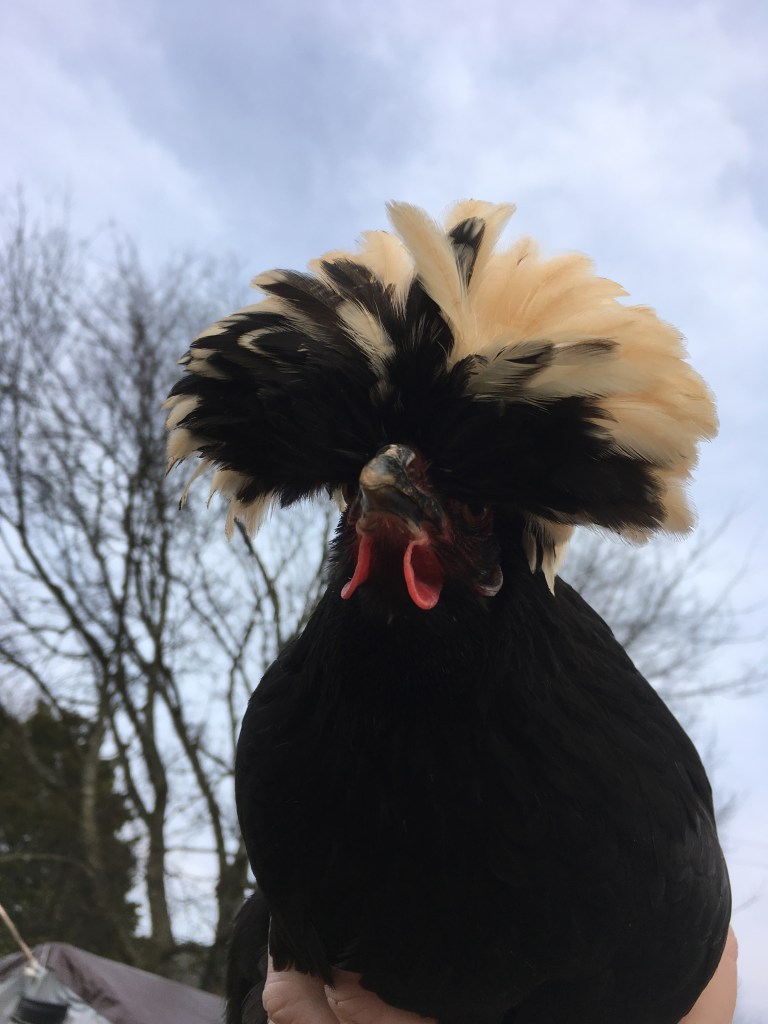
These next guys with the fabulous 80s hair are Polishes. Polishes are my favorite breed, I have more of them than any other breed on my farm. The Polishes are known as the “comedians” of the chicken world. As a breed, they are very curious but high-strung. Due to their fabulous crests, their vision is limited thus everything spooks them. Simple even mundane objects in their environment will startle them. Due to their limited vision, they cannot see what is above them. For this reason, a keeper needs to ensure that they have a covered run. If free-ranging, provide them with ample coverage as protection from aerial predators.

I only allow my polish flocks out when I am in the backyard or have multiple roosters on duty. Polish gents make great roosters for a keeper who does not mind their antics. They are very easy to pick up and hold, due to their limited vision. They are a bit high-strung making them an entertaining breed to own.

All my polish roosters are very sweet, however, curious. Due to the feathered crests, they are a bit jumpy. I talk to them before I pick them up to not give them a jolt. Characteristically, they do not make the best roosters for protection. I have ample coverage in my backyard as a hedge of protection for my polish boys.

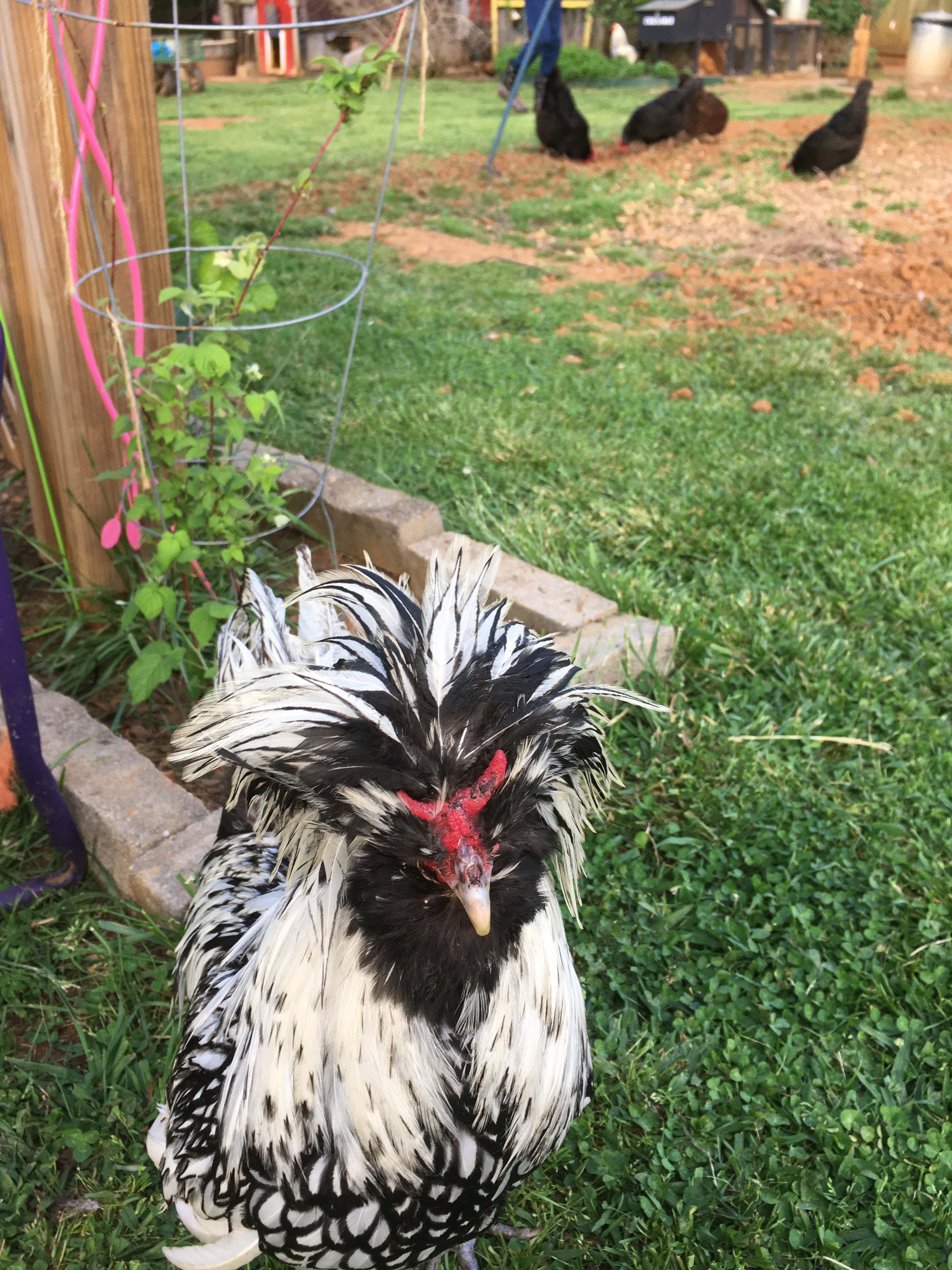
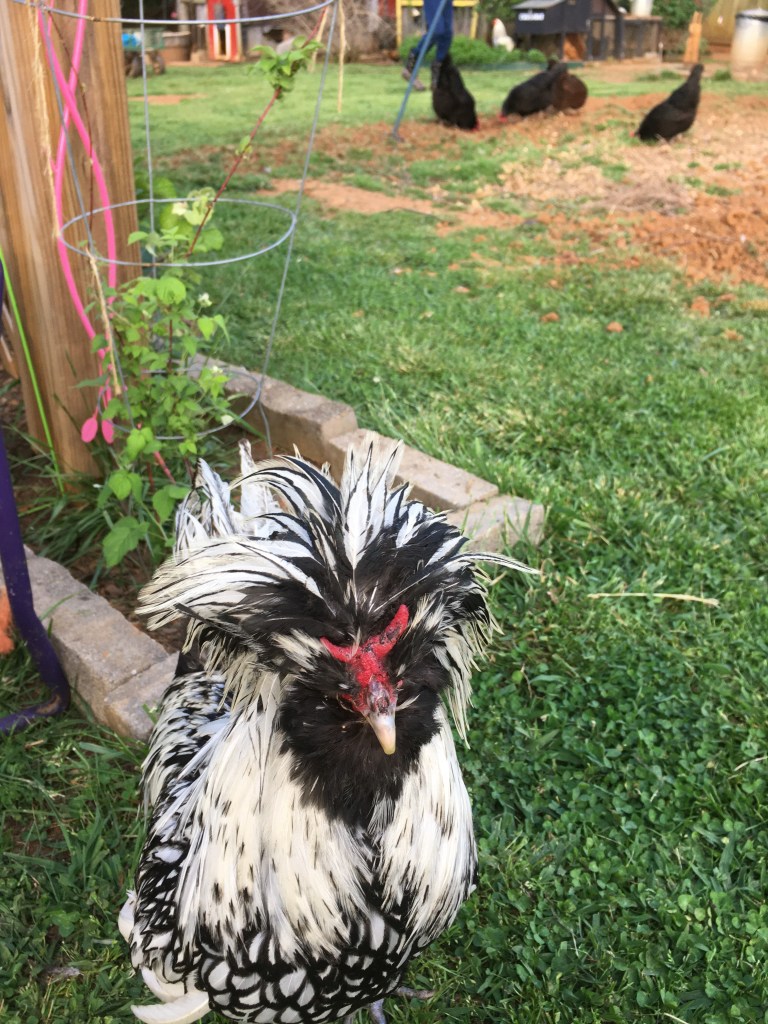
Silver Lace Polish Flock. Fi, Agatha, and Link. (Link is our Silver Lace Polish rooster).

They are very curious, often following their curiosities into predicaments, then not able to see well enough to get themselves out. They are an endless form of entertainment in the backyard. The roosters are a bit high-strung, panicky, and flighty, yet very sweet. I have several Polish roosters, all are very friendly, approachable, and curious. The ladies will often perch on my legs or arms, making them great lap chickens.

Silkie:

Silkies are known as the “Teddy Bears” of the chicken world. Due to their feathers that are “fur-like”, they are the cuddle bunnies of the flock. Silkies as a breed are known the world over for being very docile, friendly, and calm. They have voted time and time again as the best breed to have around kids.

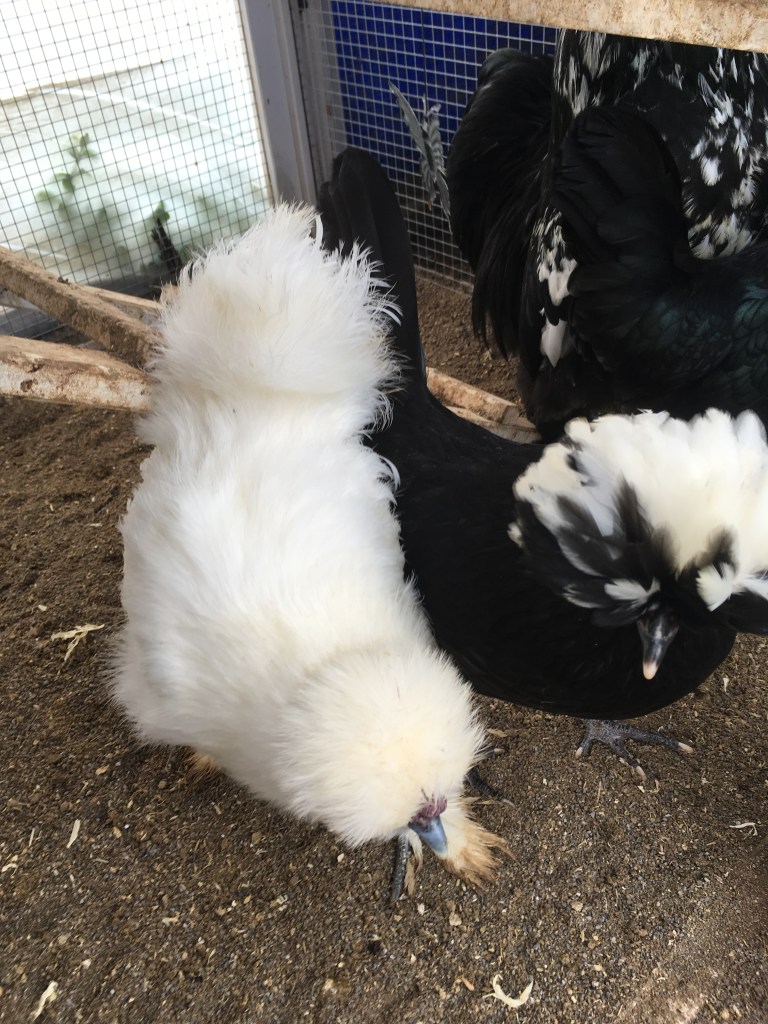
I currently have a flock of 14 Silkies, 4 are roosters. Two roosters are in the coop with the ladies, the rest are in a bachelor pen. My Silkie gents are well-behaved, shy, and timid. The ladies are very friendly and enjoy interactions with their caretakers. I have no trouble with my Silkie roosters. Like the Polish, it’s best to keep Silkies in the protection of a covered coop and pen unless you are outside with them. Due to their overwhelmingly shy nature, they would rather run from a predator than protect the ladies like most roosters. When I hold my silkie roosters, they are very docile and calm in my arms. They would rather hide under a rock but are very easygoing if I need to handle them.

Easter Eggers:

Next, Dracula and Frankenstein. These two guys are Easter Eggers and although not known as an exceptionally docile breed, these two boys are well-behaved. They are very curious and want in on whatever I am doing. Due to their breed, they are a bit larger than my other roosters. Despite their size, they are very calm and friendly. They do not like to be held, so I only pick them up when needed.

Silver Lace Wyandotte:

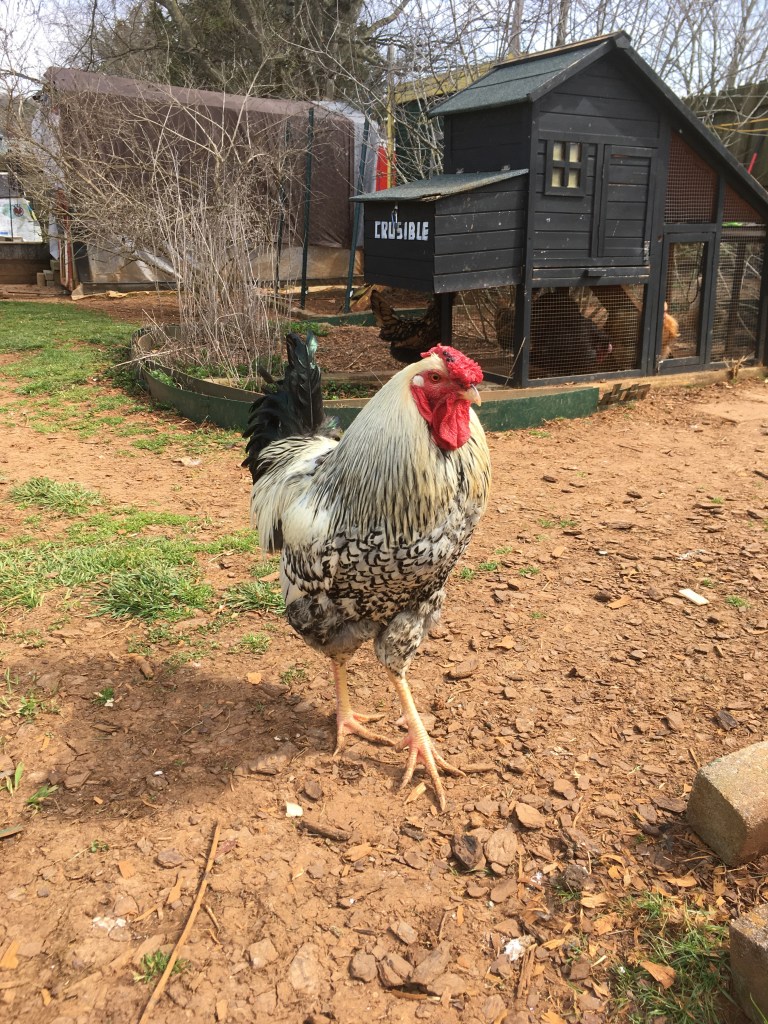
Smoug (Silver Lace Wyandotte Rooster)

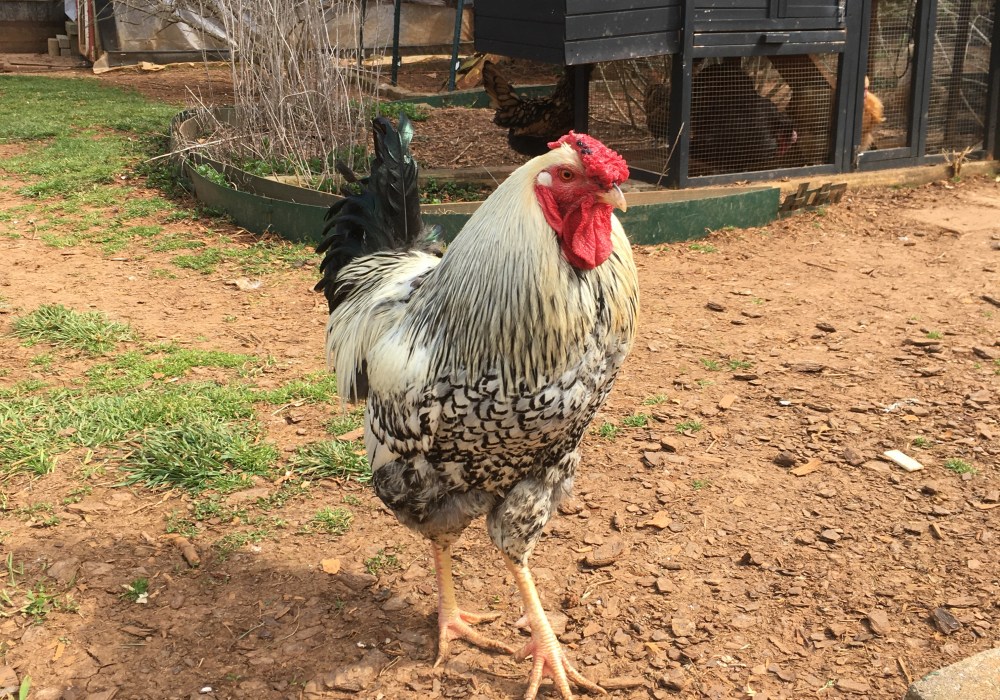
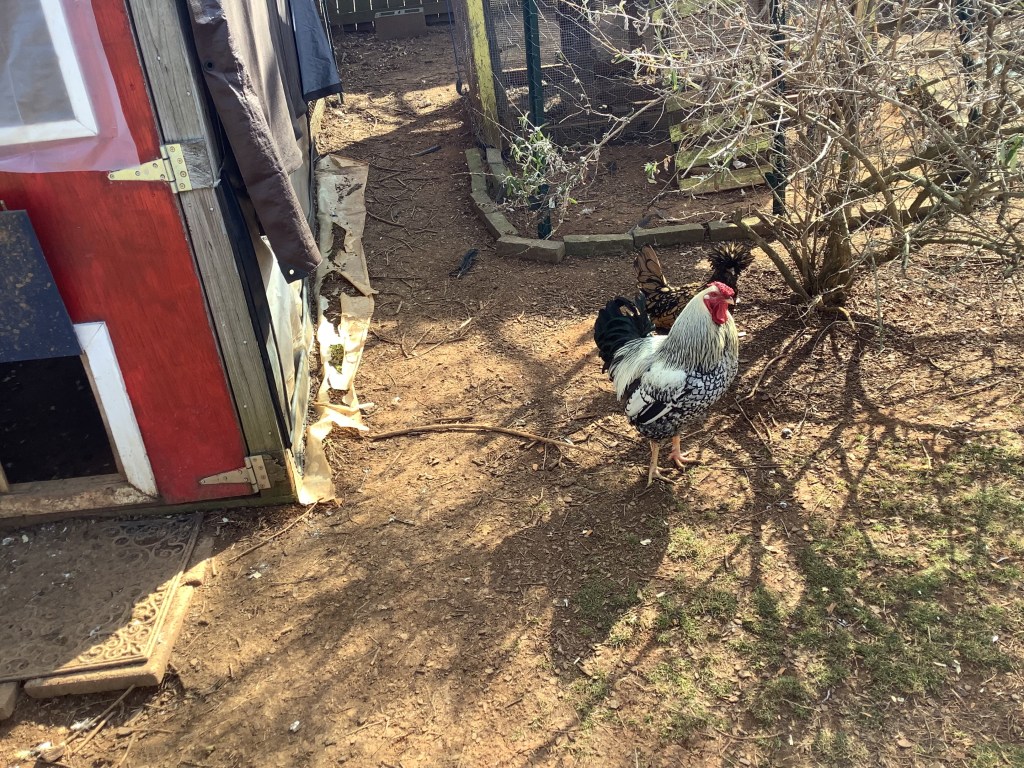
My final breed to highlight is Silver Lace Wyandottes. Wyandottes are a large breed, and Smaug is the largest member of my flock. He easily towers over the other roosters in my flock. At 12 pounds, he is a big boy. Despite his size, he is very calm, friendly, and easygoing. He is best described as the gentle giant of my flock. Due to his very relaxed nature, he is at the bottom of the rooster pecking order. I can easily pick him up and hold him when needed for health inspections. He prefers not to be held but will tolerate check-ups when needed.

While there are many more breeds available, the breeds listed I keep and can expound on associated temperament and disposition. Most roosters bred today for the backyard keeper are well-behaved. Don’t get me wrong, a rooster has a job to do, and he takes it seriously, but most are calm and friendly. I currently have 13 roosters; all are very well-behaved gents. They take good care of the ladies and are not aggressive to humans by any means. They are often my welcoming committee when I enter the backyard, curious about what treats I may have brought them.

I hope that this post has been helpful for those thinking about acquiring roosters for their flock. It is very possible to have your cake and eat it too when it comes to keeping roosters. Selecting gents from breeds that are well-known for being calm and docile is an excellent place to start. If you have any questions, please feel to leave a comment. You can also drop me a line at kuntryklucker@gmail.com

I am a published author, multi-disciplinary writer, and blog contributor. If you like my work, please visit some of my other sites.

Knowledge of the Spheres – Exploring the Celestial Spheres!

Coffee and Coelophysis – A blog about Dinosaurs

Chicken Math University – Adventures in Homeschooling

If you like this blog, please peck the subscribe button. As always, thanks for reading. Till next time keep on crowing!

~ The Kuntry Klucker Crew ~
Top 3 Rooster Management Techniques for Your Flock

Roosters, you either love them or hate them, there is no in-between. What to do with the male chicken? In some city areas, the choice is pretty clear, roosters are banned. But for those who live in the country, we have a few more options than our city-dwelling counterparts.

I am on the lover side of the rooster debate. I marvel at them as a creature and value them as an asset for my large free-ranging flock. What are the best ways to manage roosters in your flock? In this post, I will list my top three rooster management techniques.

1. Establish a bachelor pen:

After this past spring chick pick-up at local feed stores, I ended up with 7 roosters. This is the most that I have ever had in one season. I already had 6 roosters in my established flock, bringing my total rooster count to 13! But I did not freak out, why you may ask. I had a plan – A bachelor pen. Picking chicks out of the straight-run bin has its associated risks. 😊

You may be surprised to know that roosters when living together, can and do exist peacefully. Most people associate roosters with fighting when near one another. This is true if and only if hens are present. Roosters will fight to establish dominance in the presence of hens. The coveted position is that of the alpha rooster 🐓, or top dog. However, if there are no hens present, there is not much to fight over. Roosters in a bachelor pen will still maintain a pecking order but fighting will not be an issue. No hens to fight over, no problem.

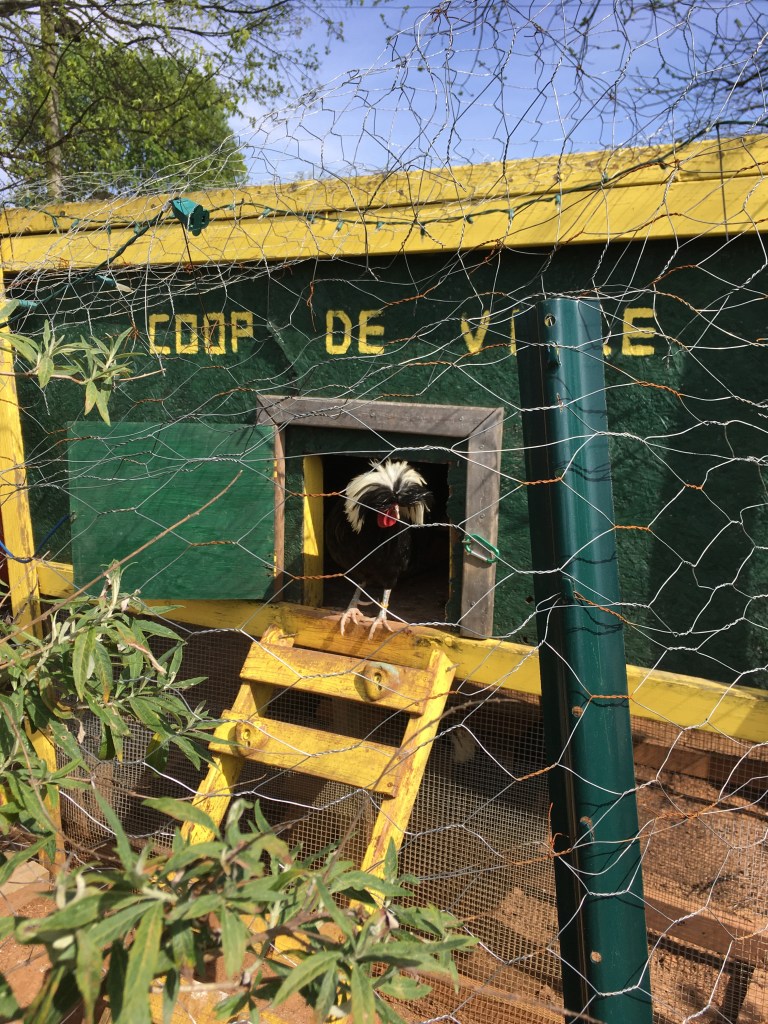
I have 13 roosters, 7 free-range with the hens, as for the rest, the bachelor life it is. The 6 residents in the Coop De Ville (bachelor pen) can see the hens, but they have no contact with the girls. Because there is no contact with the hens, there is no fighting for position. I plan to leave them in the bachelor pen. If I need an individual to perform a task such as breeding or protection, I can select from the bachelor pool. 

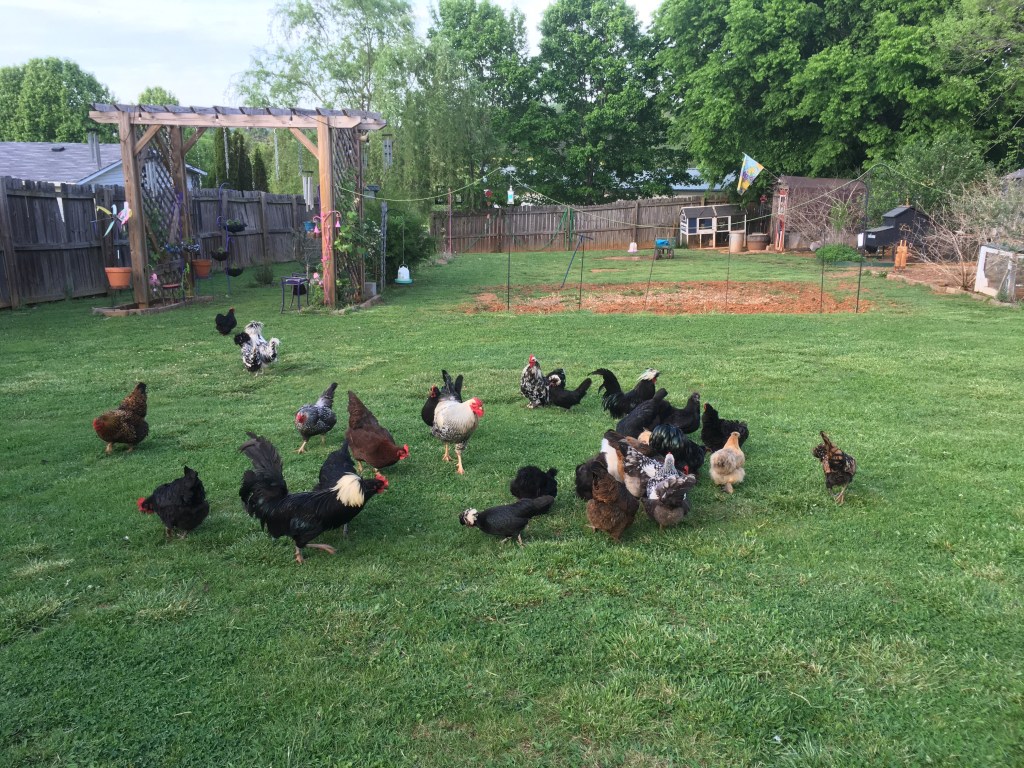
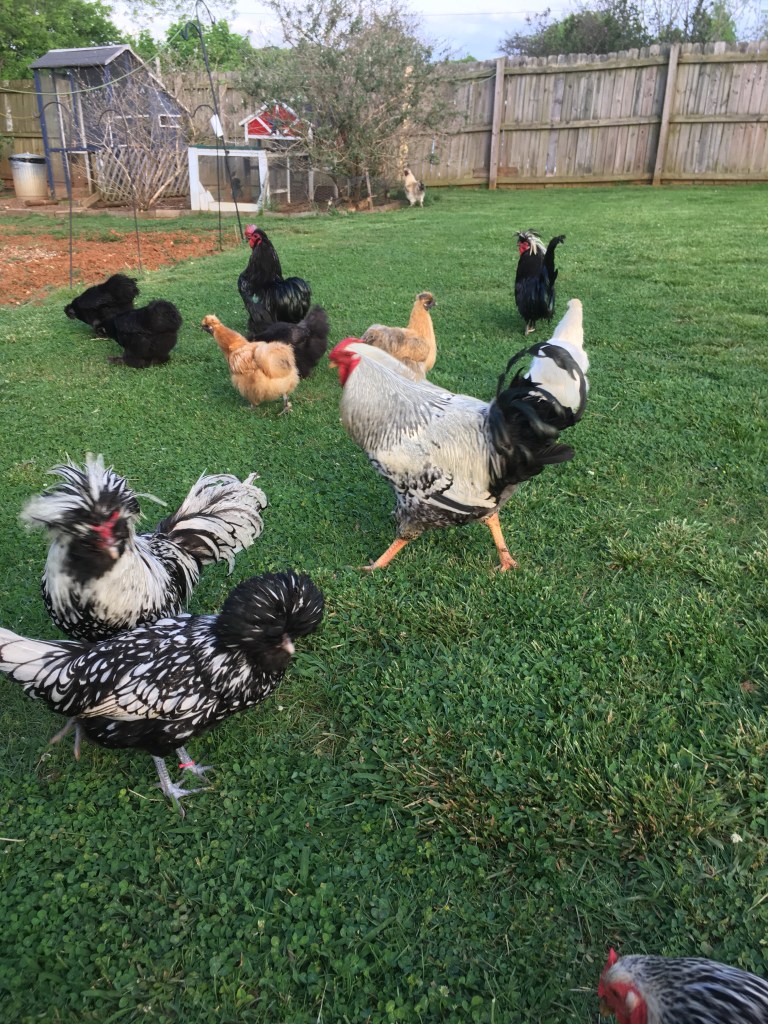
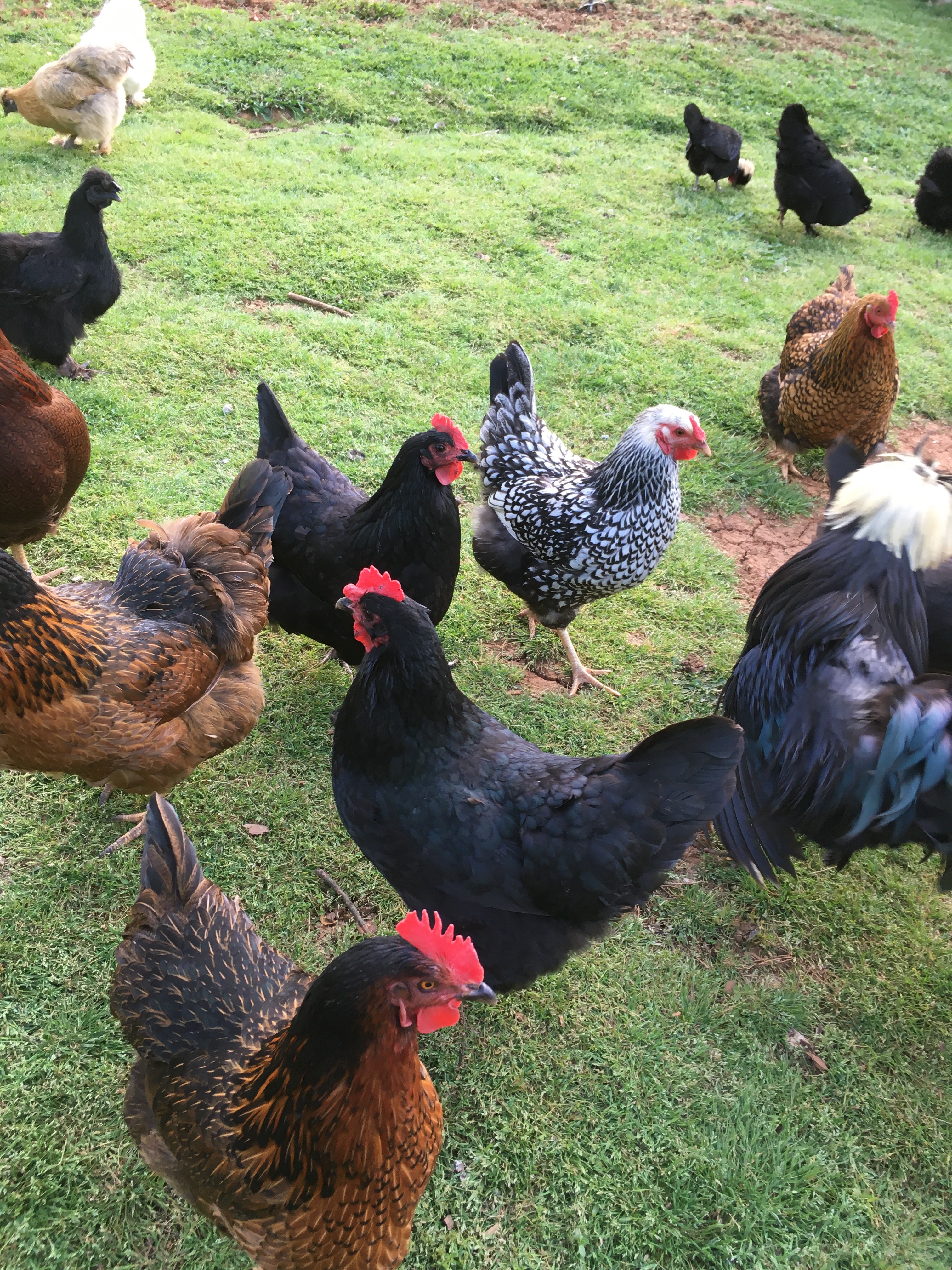
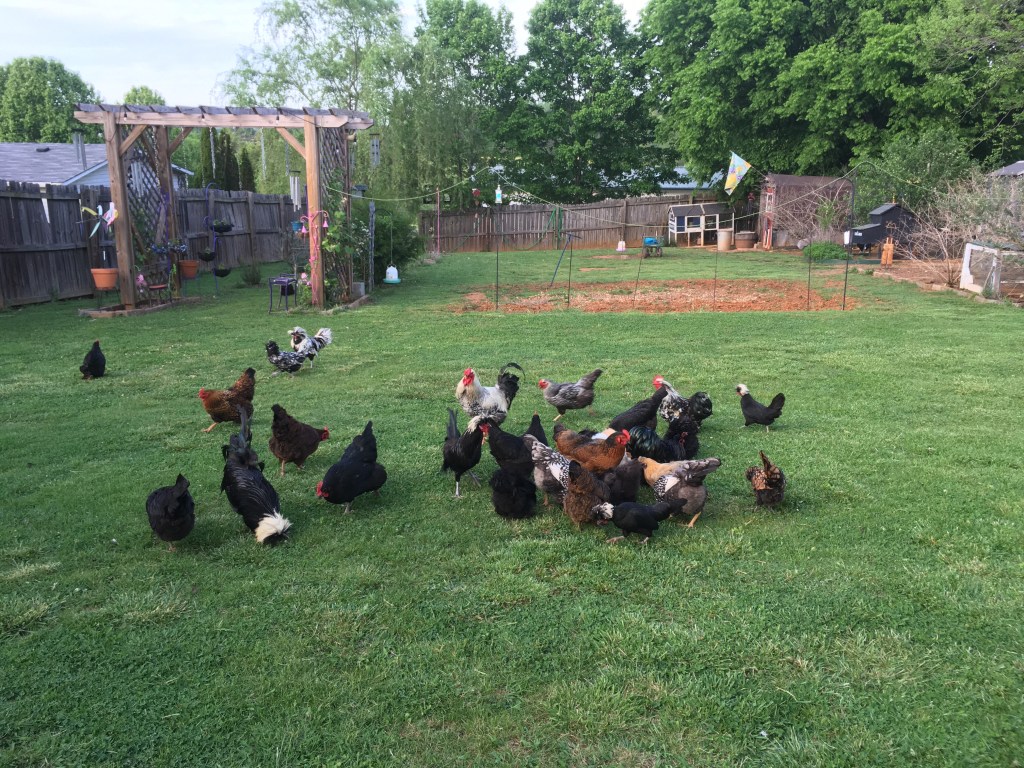
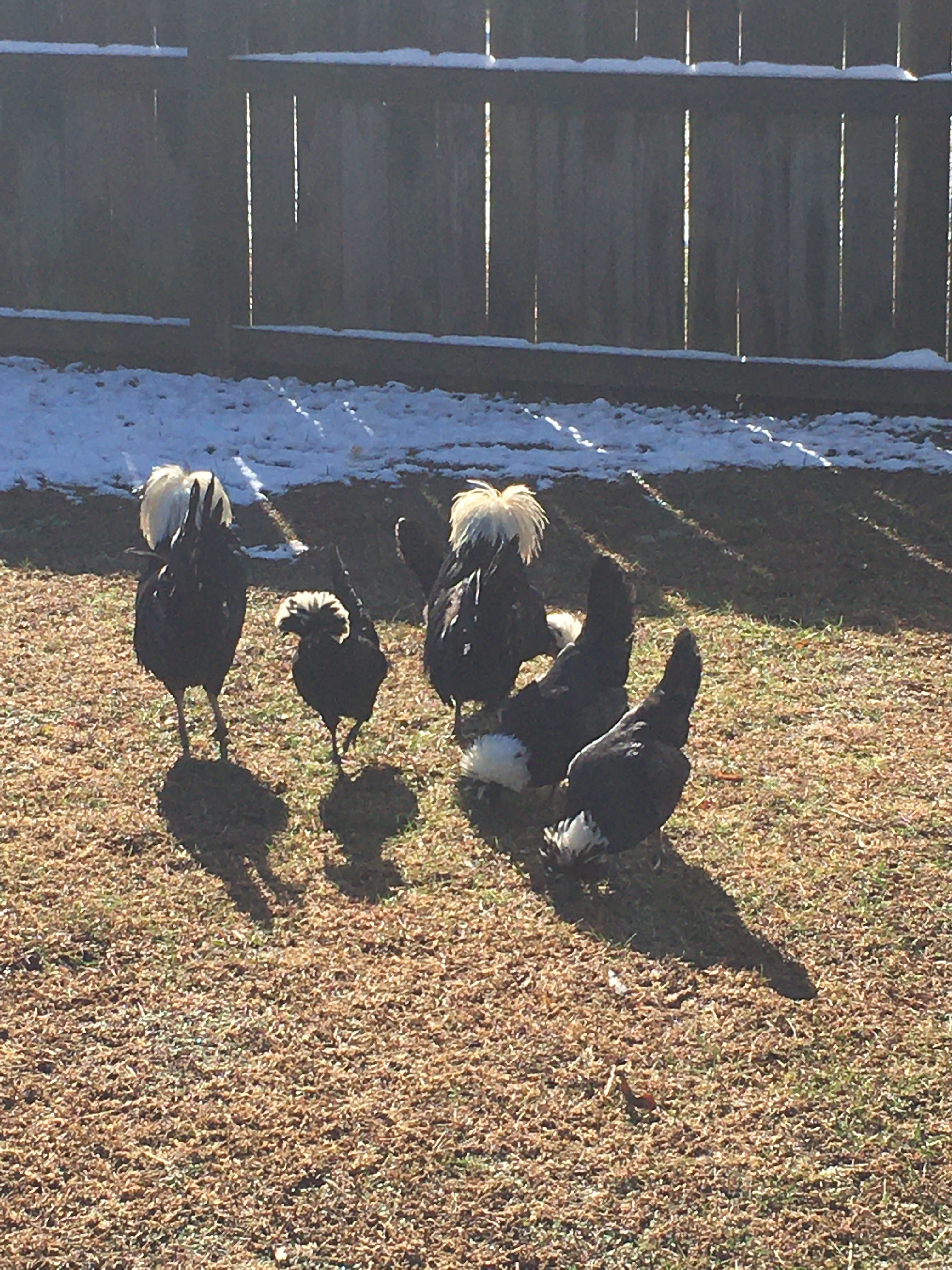
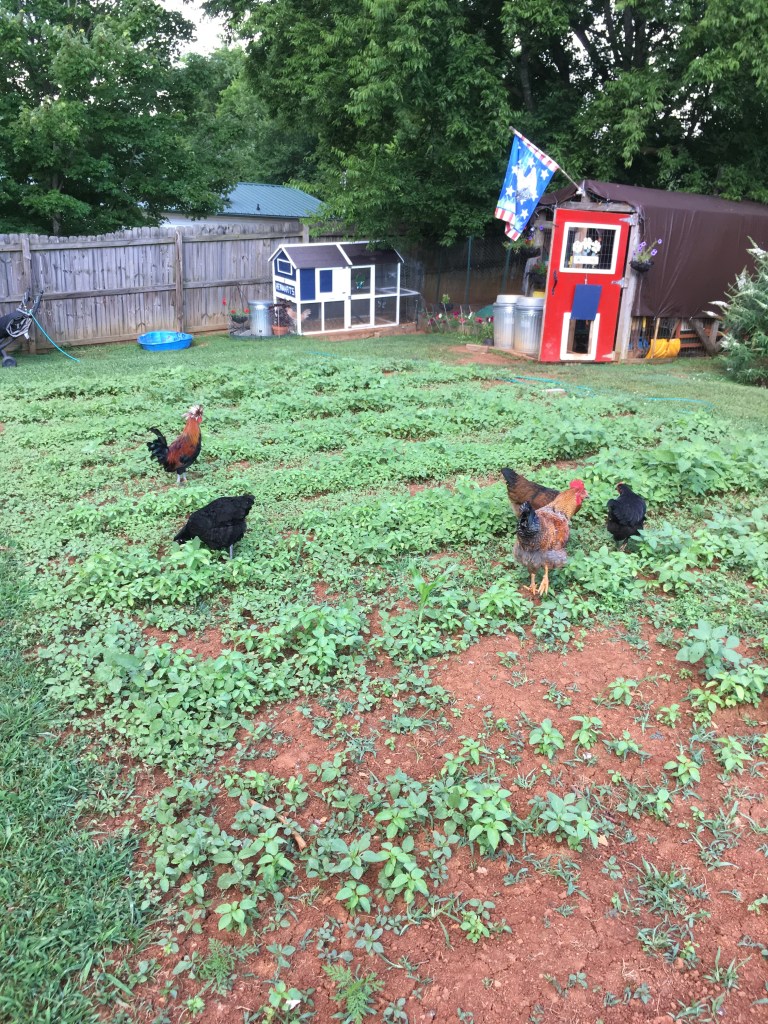
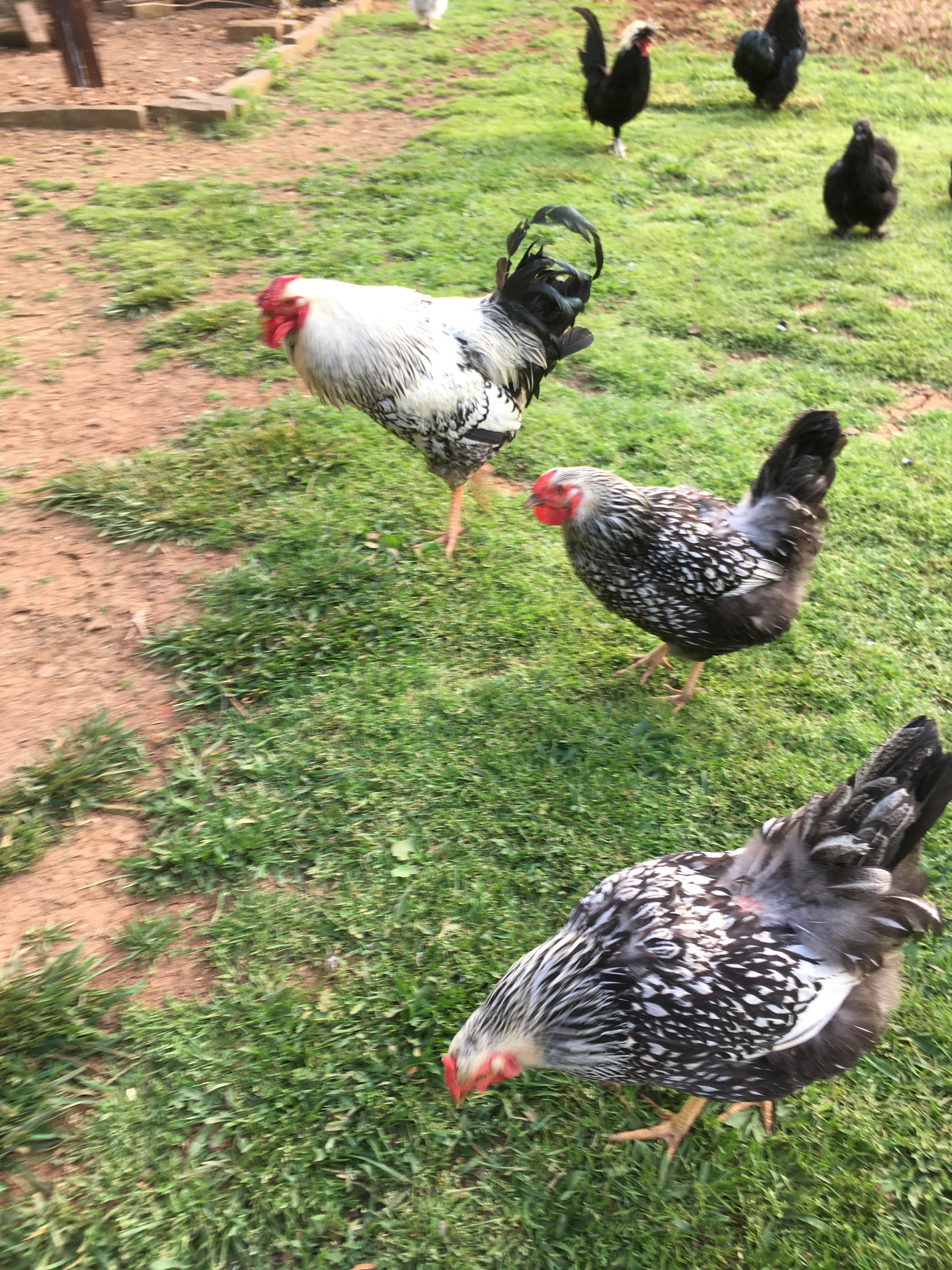
My flock free ranging. Picutred in this image are 5 out of 7 roosters that free range with my hens daily.

Having a few roosters on standby is an asset. If you free-range your flock, it is possible to lose a few roosters. A good rooster will often give his life for the flock. They are biologically wired with this protective behavior. It is for this reason that many keepers who free-range their flocks will have multiple roosters on guard. For example, I free-range my flock daily. Daily, I have 7 to 8 roosters in the yard with the girls. To date, I have never lost a rooster to a predator. I have had to nurse a few back from the brink due to injuries from an aerial attack by a raptor, but that is the extent.

2. Re-home extra roosters:

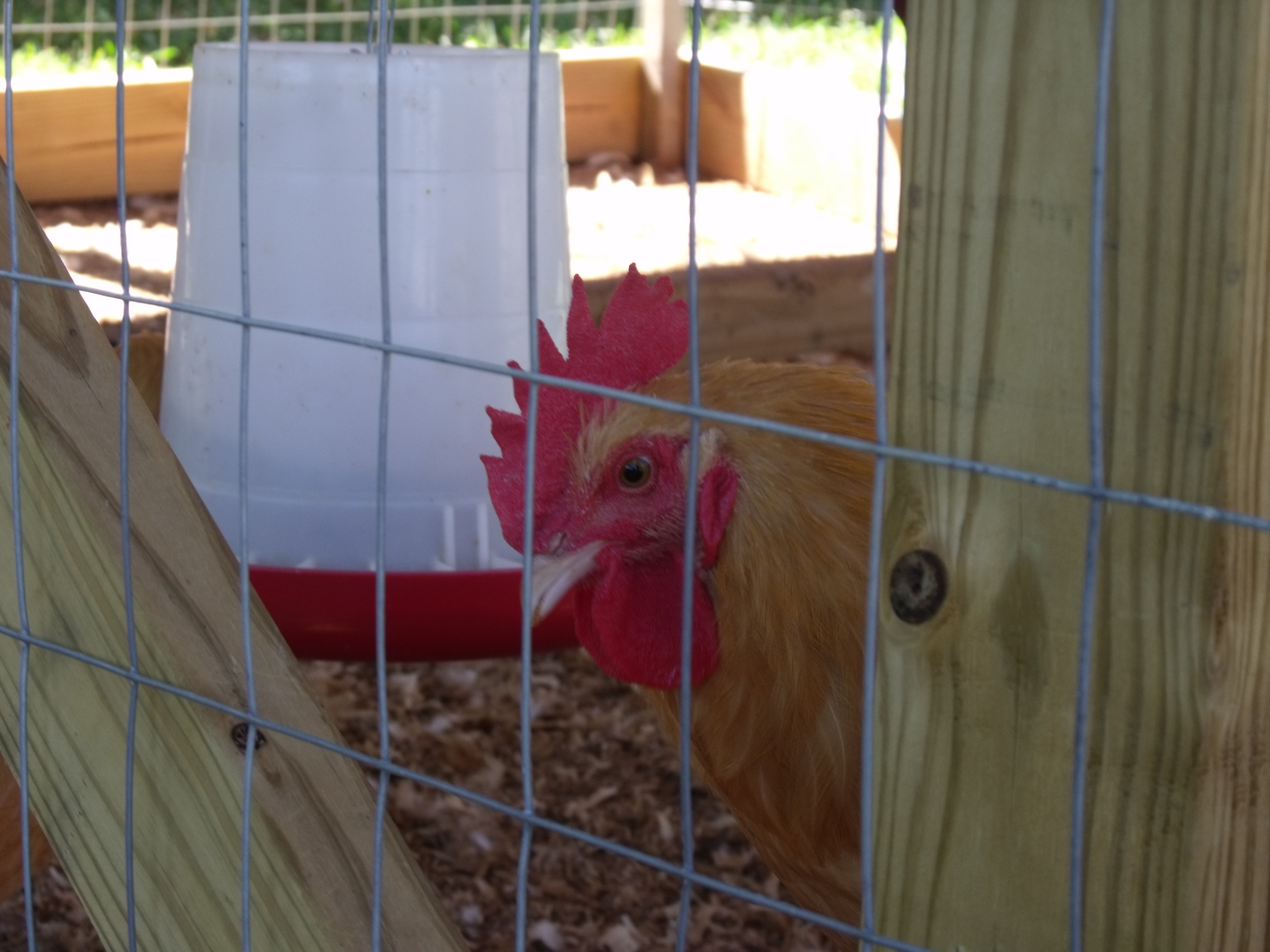
hiding behind the water
Roy (Buff Orpington Rooster). Roy was my first rooster. He taught me that roosters are amazing sentient creatures worthy of our admiration and respect.

In the past when I only had one coop, I re-homed roosters that I could not keep. This is what it sounds like, finding a new home for your surplus roosters. In my experience, it’s easy to find a new home for your extra roosters. However, when doing this, you have to understand that the new owner may see him as dinner or a fighting contender rather than a pet.

I was not aware of this when I first re-homed some of my boys. If you list your rooster online, it is possible that he will be used for illegal cock fighting. So, it’s best to take care to find a good owner for your extra boys. If you know a friend who has a large farm, they may take him for protecting their flock. Or if you know someone who is looking to breed, this is also a good re-homing choice. If you live in an area of the country where keeping chickens is very common, it’s easy to find a home for your boys. If you are a city dweller, this may be harder to come by. You may be forced to cull him or call your state veterinarian for the best option given your area.

Another option is to connect with other chicken keepers. Join a poultry club if your area has one. The backyard chicken-keeping movement is exploding all over the country. In response, many poultry clubs are popping up in every corner of the United States. A simple google search or Facebook group search will yield plenty of options. Many of these clubs offer trading/swapping/rehoming services. By connecting with other keepers in your area, you will be able to easily find a good home for your extra boys.

3.  Sell them.

🐓 Roosters-(Link, Smaug, Pantaphobia, Sec, and Supreme) keeping an eye on the activity in the backyard.

On my farm, I raise rare breeds. I have the standard Orpingtons, Easter Eggers, and Australorps that you find in most feed stores. I also have other breeds that can only be purchased from specialized hatcheries. For the rare breed boys I end up with, I find that I can sell them to others who want to breed. It is these circumstances that allow me to sell one or more of my surplus boys. The same goes for my White Crested Polish, Silver Lace Polishes, Silver Lace Wyandotte, and Buff Laced Polish roosters. They can at times go for as much as $100, especially if I throw in a few hens to seed a good starting flock.

Buying from specialized hatcheries is expensive, additionally, you have to order a mandatory minimum and then pay to ship. For those who want to expand their flock themselves, this saves a lot of money. So really, it’s a win-win-win situation. They win, I win, and the roosters win by going to a good home.

You may have noticed that none of my techniques include killing my roosters. Those are viable choices as well, for me though, I love roosters and choose to allow them to live out their natural lives. For those who can process extra roosters, a freezer camp is an option. Many people use this method to manage rooster populations in their flocks. I have nothing against this, however, since I don’t butcher my boys, I cannot speak by experience on this matter. There are many videos on YouTube on how to successfully butcher and process a rooster. For those who need tutorials, this is a great resource.

I hope that you found this post helpful. If you have any questions that I did not cover, please leave them in the comments. You can also drop me a line at kuntryklucker@gmail.com.

I am a published author, multi-disciplinary writer, and blog contributor. If you like this blog, please visit some of my other sites.

Knowledge of the Spheres – Exploriing the Celestial Spheres!

Coffee and Coelophysis – A blog about Dinosaurs!

Chicken Math University – Adventures in Homeschooling!

If you enjoyed this post, please peck the subscribe button. As always, thanks for reading!! Till next time, keep on crowing!

~  The Kuntry Klucker Crew ~

Smaug (Silver Lace Wyandotte Rooster)

5 Reasons to LOVE Silver Lace Polishes


Fi (Silver Lace Polish Hen)

If there is one breed that will always steal the show, it’s the Polish. If there is one variation of Polish that will take your breath away, it’s the Silver Lace Polish. The Polish breed of chickens has taken over the backyard chicken enthusiasts’ movement by storm. This year, the number one selling chicken breed, you guessed it, the Polish. What is it about the Polish breed that has backyard chicken keepers so smitten?

Fi (Silver Lace Polish Hen)

Polishes are characteristically very quirky, entertaining, and affectionate. Due to the ample feathered crests that crown their heads obstructing their vision, Polishes can be a bit flighty and jumpy. Just about everything in their environment startles them, and for this reason they are often the comedians of the backyard chicken world. In addition, they are very curious, often following their curiosities into humorous predicaments. Unable to see well enough to get themselves out, they call for other members of the flock to come to their rescue. For this reason, the Polish breed can be a bit more vocal than other breeds. It is this combination of attributes that makes Polishes one of the most beloved breeds within the backyard chicken movement. Now that the Polish breed has our attention, many new variations are becoming more readily available. One of the most loved variations is the Silver Lace Polish. Here are my top 5 reasons why Silver Lace Polishes are topping the charts.

(1). Stunning Appearance:

Fi and Agatha (Silver Lace Polish Hens)

Let’s start with the obvious. These ladies and gents are absolutely beautiful!! They look like something right out of a Van Gogh painting. The command of color and contrast in their plumage leaves the observer breathless. The densely feathered crests topping their head completes the look. These fancy gals and gens appear as though they are dressed up for a chicken Gala. All of these attributes combined comprise their unique appearance that commands the attention of anyone who happens upon them. Make no mistake, Silver Lace Polishes will quickly become the gems of the flock. Many keepers including myself, keep these beauties to enter poultry shows. When not winning ribbons, Silver Lace Polishes add a bit of refinement to a backyard flock.

Often the first comment I get from visitors addresses my Silver Lace Polishes. They inquire about their unique appearance; some disbelieve that they are in fact chickens. The unique appearance of the Silver Lace Polish leaves onlookers and keepers captivated by their beauty.

Link (Silver Lace Polish Rooster)

The roosters of the Silver Lace variety are even more spectacular. The additional tail and crest feathers take their ravishing look a step further. Roosters command attention, but Silver Lace Polish roosters leave the observer breathless. These ladies and gents are by the far the most loved individuals of the backyard chicken Polish enthusiast. I have several Polish color varieties; the Silver Lace is hands down my favorite.

(2). Friendly, funny, feathered friends:

My son holding our Silver Lace Polish flock (Fi, Agatha, and Link)

The Polish are known to be a very friendly, affectionate, docile, and curious breed. Silver Lace Polishes are much like their other Polish breed counterparts. The only difference between Silver Lace Polishes and other varieties is the feathered plumage. They possess all of the challenges that other Polish varieties possess.

They are very curious, friendly, and form a strong bond with their keepers. Due to their feathered crests that obstruct their vision, they can be flighty and jumpy. To keep Polish chickens successfully, a keeper must make sure to provide a covered pen, confined free-ranging space, and ample coverage. The feathered crests limit their ability to see what is above them, making them easy prey for aerial predators. Additionally, due to their crests feathers, they can be high-strung. Because of this, a keeper must be aware when picking them up as they may startle. It is this combination of attributes that makes them entertaining to keep and watch.

(3) Great for an Urban setting:

Silver Lace Polish Flock

If you live in the city limits or a neighborhood and want fancy chickens, you’re in luck, Silver Lace Polishes fit the bill. All Polishes, including Silver Lace Polishes, tolerate confinement well, making them perfect for the urban setting. Due to their feathered crests, Polish chickens tend not to stray too far from the safety of their coop. If a threat is detected, they like to be close to a place of safety. Because of this, they tolerate confinement in a coop and pen very well. Other more adapt breeds for free-ranging such as the Australorp, Rhode Island Red, and Orpington become restless when confined to a coop and pen.

Another plus for the urban chicken keeper is the body size of the Polish chicken. Silver Lace Polishes and all Polish chickens come in both a standard and bantam (miniature or ornamental) size. Even the standard-size Silver Lace Polish chickens are a bit smaller than most standard-size breeds. This is an added benefit to the urban keeper. Due to their size, Silver Lace Polishes are easier for a city keeper to accommodate on smaller plots of land.

(4) Egg Potential:

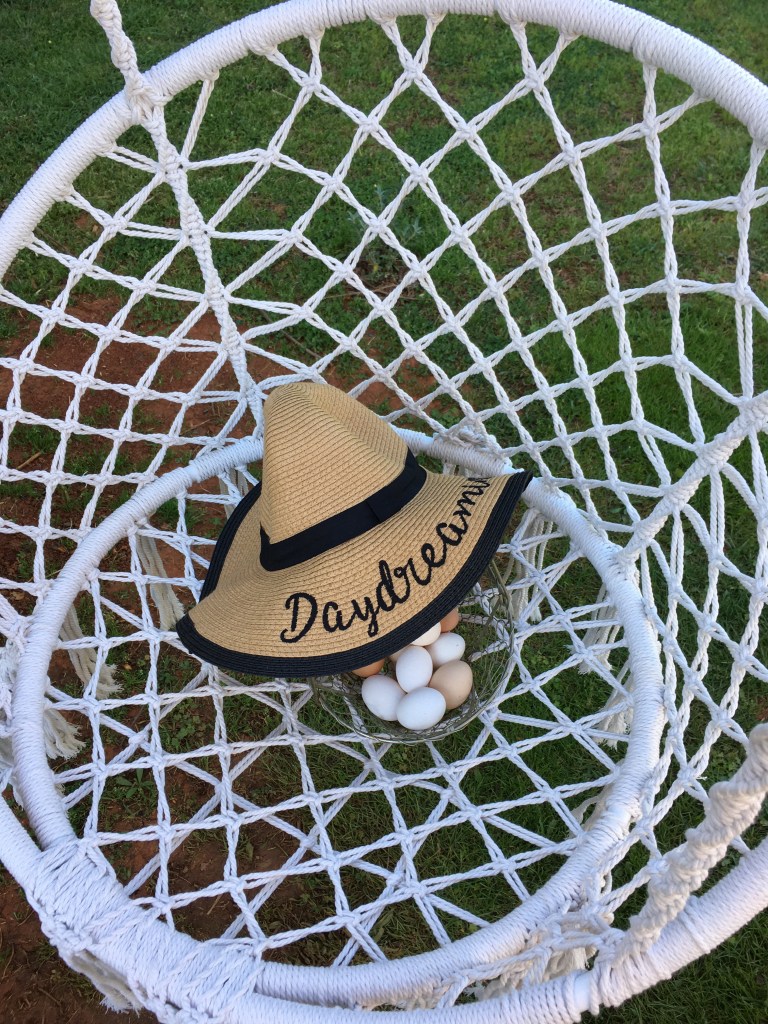
Egg basket of the girls work day. White eggs are from my Polish chickens.

Contrary to popular belief, Polish chickens lay a fair number of eggs. They are by no means record holders like the Australorp or Orpington, but they do lay eggs. For those who want a small flock for an urban plot or hobby farm, Silver Lace Polishes are great. They will give you enough eggs for your family without overwhelming you with an egg surplus.

Polish eggs are typically a medium size and white to off-white in coloration. One hen will typically lay anywhere from 2-3 eggs per week. Some hens may lay more, others may lay less. On average, I can expect one of my Silver Lace Polishes to lay an egg every three days.

Another benefit closely related to egg production is broodiness. Polish chickens are not known for being broody, for the urban keeper, this is a huge benefit. Not distracted by wanting to brood a clutch of chicks, they will give more attention to you, their keeper. This sets the Polish apart making them truly “pet” chickens. This brings me to my last point.

(5). The Ultimate Pet Chicken:

Silver Lace Polishes, Polishes and more Polishes.

If what you are in the market for is a “pet chicken”, Silver Lace Polishes are a breed to consider. They are a quirky, loveable, friendly, and approachable breed. Due to their feather head crests, they are easy to catch and pick up, which makes them great for being around children. This means that Silver Lace Polishes are great for a family flock. Pet chickens are a great way to teach kids how to take care of animals, responsibility, and respect for other creatures. As the saying goes, “chickens are the gateway drug to farming” thus, a great way to teach lessons in sustainability. Being that Silver Lace Polishes and all Polishes are so friendly, they are great to have around an urban backyard hobby farm.

Fi and Link (Silver Lace Polishes); Smaug (Silver Lace Wyandotte Rooster)

I hope that you have found this post helpful. If I did not address any questions that you may have regarding Silver Lace Polishes, please leave a comment or drop me a line at kuntryklucker@gmail.com.

I am a published author, multi-disciplinary writer, and blog contributor. If you enjoyed this blog, please visit some of my other sites.

Knowledge of the Spheres – Exploring the Celestial Spheres!

Coffee and Coelophysis – A blog about Dinosaurs!

Chicken Math University – Adventures in Homeschooling.

If you enjoyed this post, please peck the subscribe button. As always, thanks for reading. Till next time, keep on crowing.

Polish chroes line (Deaky, Fi, and Freddie)

~ The Kuntry Klucker Crew ~

5 Reasons to LOVE Silver Lace Wyandottes

Sapphira (Silver Lace Wyandotte Hen)

When one thinks of fancy chickens, Silver Lace Wyandottes often come to mind. With the striking black and white plumage forming a lace pattern, it’s hard to not love these ladies. These lovely ladies and gents are uniquely American, dating back to the 1800s with admission into the Poultry Standard of Perfection in the 1890s. As an American breed, Wyandottes have become synonymous with the backyard chicken movement in the United States. Widely available at most farm and feed stores, Wyandottes are the poster chick for the American backyard flock. They say that beauty is only skin deep, not for these ladies. After keeping these fancy ladies (and gents) for several years, I have compiled 5 reasons to be head over heels for Silver Lace Wyandottes.

(1) Beauty :

Let’s start with the obvious, these girls are stunning. In a flock by themselves or in mixed flocks, these ladies steal the show. The black/white lace pattern of their plumage is striking against the background of a freshly cut green lawn. If you want to add a bit of high class to your flock, you can’t go wrong with Silver Lace Wyandottes.

Visitors to my farm, often inquire about my Silver Lace Wyandottes. As a breed, they are showstoppers and often the subject of discussion. Visitors cannot get over the beauty this breed brings to the backyard setting. I am often asked for fertile eggs so they too can have a flock of these stunning ladies.

(2) Gentile, Docile and Enduring Disposition:

Sapphira and Brisinger (Silver Lace Wyandotte hens)

If you are looking for a breed that is docile and friendly, Silver Lace Wyandottes are a great fit. When I step into the chicken yard, my Silver Lace ladies are often first to greet me. They are excited at my presence, whether I bring treats or come empty-handed. They love attention and enjoy handling and petting. If you are in the market for a lap chicken, Silver Lace Wyandottes are the breed for you.

My Silver Lace Wyandottes leading the flock to greet me as I step into the backyard.

Silver Lace Wyandottes as a breed are very curious. They always have to get into and investigate anything that I am doing, whether it be planting crops, cleaning coops, or yard care. They are my supervisors, always wanting in on what I am doing. They are very sweet, offer plenty of “hen-help”, and want nothing more than the full attention of their keeper.

Smaug (Silver Lace Wyandotte Rooster)

Silver Lace Wyandotte roosters are well-behaved and friendly. Smaug, our resident Wyandotte rooster is a gentleman. He takes good care of his ladies and is friendly toward his humans. He is as close to a cuddle bug as a rooster can get. I have 13 roosters of various breeds, all are very well-behaved, but Smaug gets the prize. At 12 pounds, Smaug is a gentle giant and the cornerstone of the Kuntry Klucker Farm.

(3) Dependabel Egg Layers

Wyandottes are excellent layers of X-large dark brown eggs. The Australorp, also known for being an excellent layer is only outclassed by the Wyandottes in terms of egg size. While the Australorp gets the prize for the most eggs laid in a year (364 is the world record), Wyandottes are larger, proving that quality is better than quantity. In the photos above, I have placed a Silver Lace Wyandotte egg next to an Australorp egg. While the Australorp egg is dark brown and large, the Wyandotte egg (sitting to the left) is slightly darker and noticeably larger. When I first started getting eggs from my Wyandottes, judging by the size, I figured them to be double-yoker. However, this is not the case. Wyandotte eggs are very large and a beautiful dark brown. These are by far the largest eggs I have ever received from my backyard flock. With eggs this size, I plan to keep Silver Lace Wyandottes in my flock for years to come.

(4) Made in America:

If you are looking to buy American, Silver Lace Wyandottes are it. While most beloved backyard chicken breeds have origins in another part of the world, Wyandottes are born and bred in America. Uniquely an American breed, Wyandottes were first developed in the 1800s, properly named after the indigenous Wyandotte people of North America.

Silver Lace Wyandottes are a Heritage Breed. One of my principal passions within the backyard chicken movement is the conservation of Heritage Breeds. In 2015, Silver Lace Wyandottes were listed as “endangered” by the Livestock Conservancy. As of 2020, they were listed as “recovering”. Today they are no longer endangered and removed from the list.

Smaug (Silver Lace Wyandotte Rooster)

It is through our efforts as backyard chicken enthusiasts that these beautiful birds are thriving. Without backyard chicken keepers, breeds like the Silver Lace Wyandottes and others would easily slip into extinction. While keeping backyard chickens is an exciting hobby, its roots run much deeper. As a backyard chicken keeper, you are also acting as a conservationist. All of us play this important role, whether we are aware of it or not.

(5) All Weather Breed:

Sapphira, Brisinger, Eldest and Smaug (Silver Lace Wyandotte flock)

Unlike other breeds such as the Silkie or Polish, Wyandottes can tolerate many different climates. They come factory installed with this superpower which has made them one of the most enduring breeds in the United States. Due to their rose comb, Wyandottes tolerate cold climates without suffering issues of frostbite as other larger comb breeds often encounter. Although heavily bodied, Wyandotte perform well in hotter climates.

For Example, here in East Tennessee, mother nature throws it all at us. In the winter we experience ice and snowstorms. In the spring we experience strong/severe storms, many with torrential rains and the threat of tornados. The summer is hot and humid, summer highs easily top 90-100F. Through it all, my Silver Lace Wyandotte ladies don’t seem to mind what the wild weather here does, they just keep on keeping on. In an area that encounters many different kinds of weather, this is an attribute that a keeper should look for in the breeds they choose.

This ease-of-care breed has quickly risen to the top of my favorites list. If you are looking for a breed that is easy to care for, Silver Lace Wyandottes are a breed to consider. If you want a colorful flock, Wyandotte chickens come in a variety of colors (Golden Lace, Buff, Partridge, Silver Penciled, Columbian, and Blue/Red Lace).

I hope this post has been a helpful breed profile for those interested in keeping Wyandotte chickens. If you have any questions I did not cover, please post in the comment section, or drop me an e-mail at kuntryklucker@gmail.com.

I am a published author, multi-disciplinary writer, and blog contributor. If you like my work, please visit some of my other sites.

Knowledge of the Spheres – Exploring the Celestial Spheres!

Coffee and Coelophysis – A blog about Dinosaurs!

Chicken Math University – Adventures in Homeschooling.

If you enjoyed this post, please peck the subscribe button. As always, thanks for reading. Until next time, keep on crowing.

~ The Kuntry Klucker Crew ~

The Useless Rooster.

Many people associate roosters with being aggressive nightmarish birds recalled as the barnyard terrors we encountered on our grandparents’ farm. Sadly, roosters are often type cast into this role by an unfair association.

Roosters are amazing creatures, worthy of admiration. Recent breeding methods have changed as the backyard chicken movement has exploded and evolved. The selective breeding methods by many breeders have yielded roosters better suited for the backyard setting. In our grandparents’ day, when a flock was kept for food be it meat or eggs, a defensive rooster was needed. However, chickens today are kept more often as pets that have the benefit of making breakfast.

The breeding industry has responded, breeding for behavioral trait qualities such as docile, calmness and friendly. Many breeds available today have roosters that possess these qualities. Breeds like the Polish, Silkie, Cochin and Orpington all are breeds that are widely available that typically have well behaved roosters. I have all of these breeds and can validate for good behavior in roosters of the aforementioned breeds.

Don’t get me wrong, roosters have a job to do and take it seriously, but most backyard flocks have well-behaved gents. Sometimes, a rooster can be so well-behaved that they are for all purposes useless.

How can a rooster be useless, you may be wondering. Allow me to introduce you to Pantaphobia, the useless rooster.

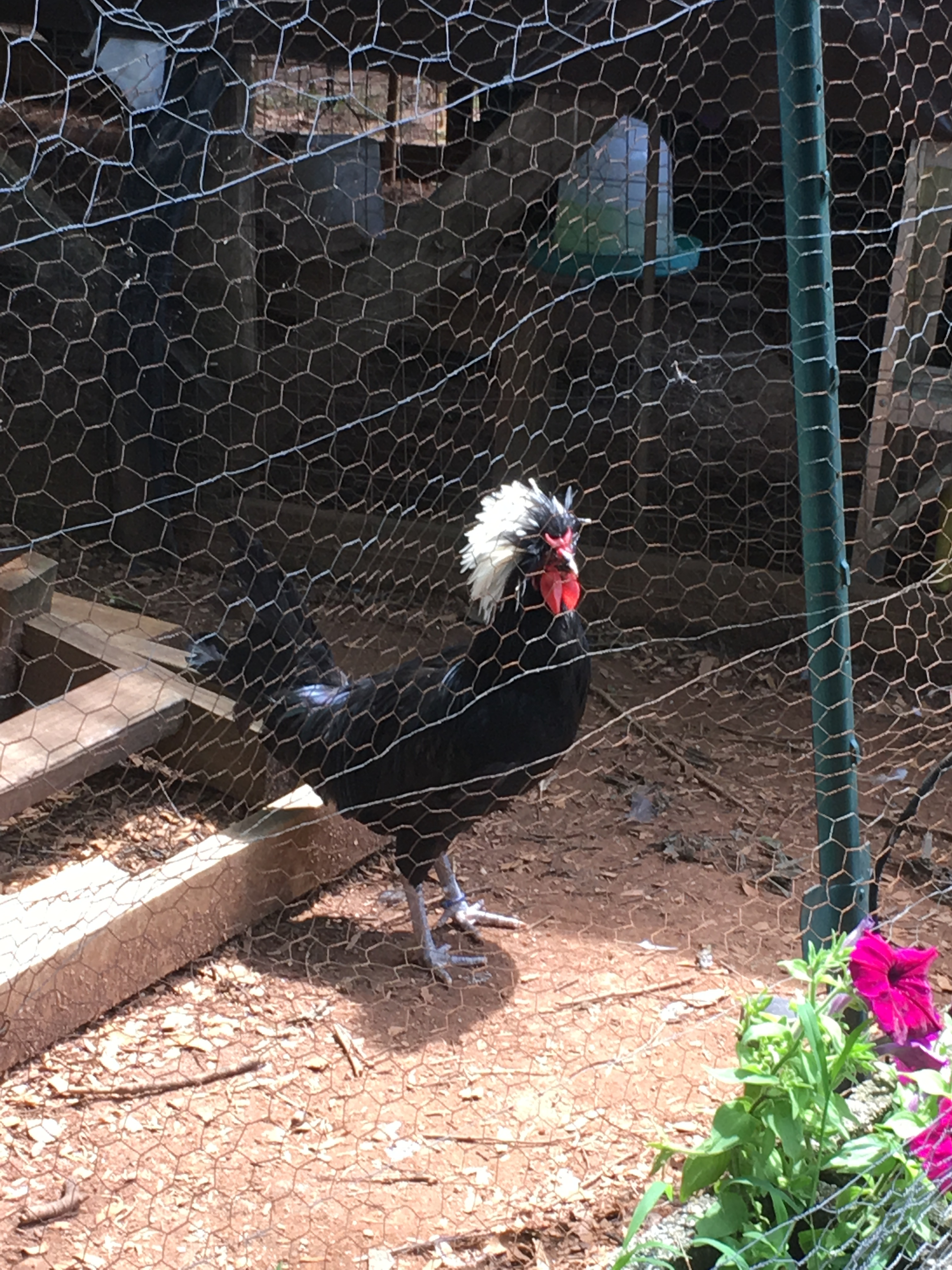
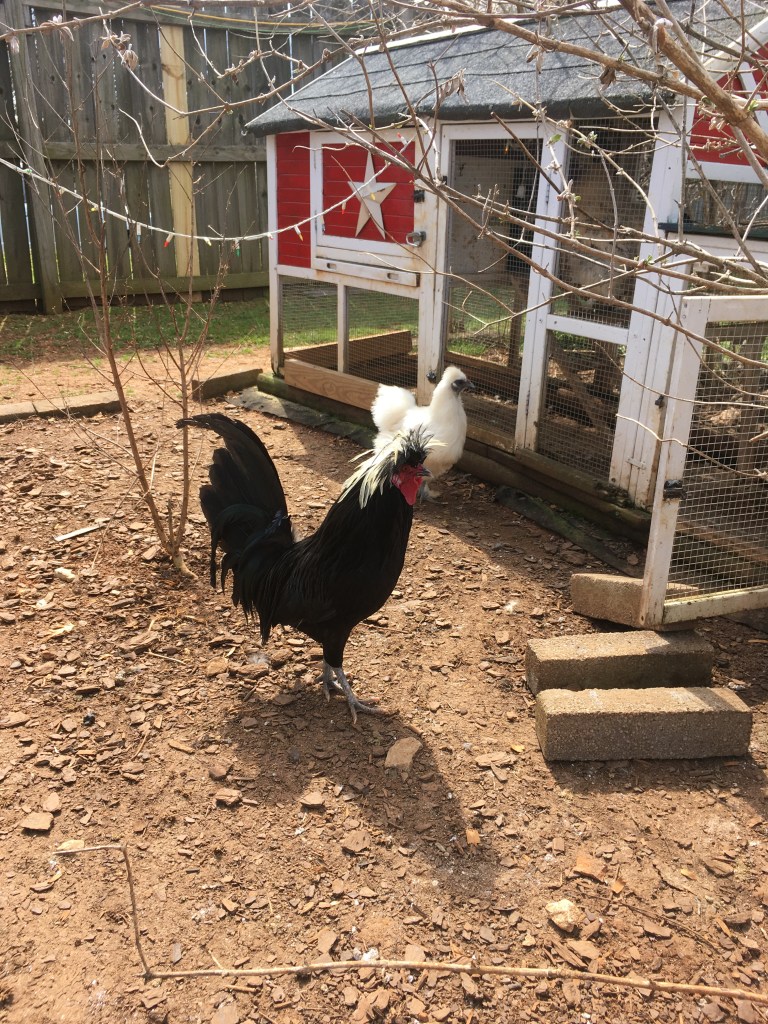
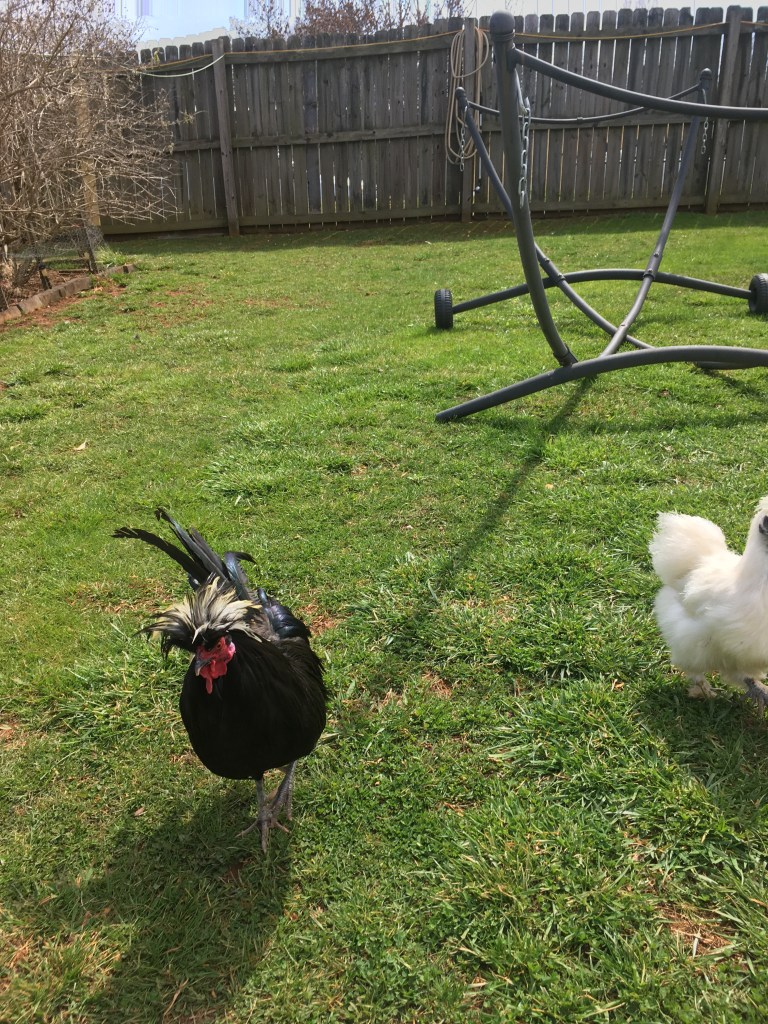
White Crested Polish Rooster: Pantaphobia

He is afraid of food:

Pantaphobia is not the fear of pants, it’s the fear of everything, including pants. As his name suggests, Pantaphobia is afraid of absolutely everything. He is afraid of ordinary mundane things chickens often encounter in their environment, such as bugs. While the other chickens in the flock can be seen chasing a juicy morsel like a fly or a moth, Pantaphobia is often running from these meals to go. Since he is also afraid to go into the coops, this also means that he does not partake of the food readily available in the feeders. He lives on weeds, grass, worms, and other morsels that he can find crawling on the ground.

He never hunts for the girls:

One of the necessary things that a rooster does for his flock is a food search. A rooster will take it upon himself to actively look for morsels for the girls to eat. Once he finds something of value, he calls his girls over to partake in his hard work. It is by evolutionary design that a rooster knows that the hens need extra nutrition to sustain the flock population. If there is anything left, only then will he eat. A rooster is a self-sacrificing soul, caring more for his hens than himself. He is more concerned about their welfare than his. Pantaphobia is quite the opposite. He spends most of the day occupying himself with hunting for grubs in the grass, but he has no interest in sharing with anyone, including the hens.

He Never Mates with the Hens:

One thing that a rooster is supposed to be able to do very well is mating with the hens. In Pantaphobia’s case, this too is something that he elects not to participate in. He will never approach a hen with the intent to try to woo her for a date. He simply ignores the hens and occupies his time looking for grubs to dine on. For this reason, he never gets into many confrontations with the other roosters in the flock. He simply keeps to himself, hunting and pecking his way through the day.

He never warns the flock of danger:

It is a rooster’s primary job to keep an eye on the skies, constantly scanning for danger. While out in the yard with the rest of the flock, it is the other gents that keep watching for any threats. If the alarm is sounded, Pantaphobia will run for cover along with the hens. He will not attempt to protect the girls from the imminent threat like the other roosters in the flock. He simply runs and hides till the “all clear” is announced.

He hardly ever crows:

If there is one attribute that is always associated with roosters, it’s crowing. Roosters crow for many reasons, to establish dominance in the flock, to check in with the other roosters when free ranging, to warn the flock of danger, and just because they can. Pantaphobia, on the other hand, has no interest in this time-honored tradition. He will sometimes crow in the mornings as dawn moves over the land, but other than that, nothing. He is the quietest rooster that I have ever had. Early on, I wondered if he was a hen, but there is no question, anatomically and definitively he is a rooster.

So, why keep him?

You may be wondering why I would hang on to such a useless rooster. Well, here on The Kuntry Klucker Farm, I allow my ladies and gents to live out their natural lives. I keep Pantaphobia for the same reason that I keep my senior hens who are no longer laying, all have value. Although he performs absolutely no service for the flock, he is still a delight to watch.

Additionally, he is a White Crested Polish, my favorite breed. The Polish have the habit of being flock comedians, due to their head crests that obscure their vision. Pantaphobia does not disappoint in this department. While the other Polish residents have figured out what to be afraid of and what not to fear, Pantaphobia has not. The other Polish members will actively chase after a flying treat, Pantaphobia will run in terror. You have not adequately spit out your coffee till you see a rooster run from a butterfly.

While he may be useless in every other sense of a rooster’s role in the flock, he is not a disappointment when it comes to the entertainment value. In this respect, I got my money’s worth and then some.

I hope you have enjoyed this post. While most of today’s roosters are well-behaved (a far cry from the game-like aggressive breeds of yesterday), roosters come in all personalities. Some make good caretakers of the hens, others not so much. A rooster is a creature that it is worthy of respect and admiration, even those who are a bit of the special needs variety.

If you have any questions about roosters or chicken keeping in general, please leave me a comment. I make it a priority to respond in 24 hours. You can also drop me a line at kuntryklucker@gmail.com.

I am a published author, multi-disciplinary writer, and blog contributor. If you like this blog, please visit some of my other sites.

Knowledge of the Spheres – Exploring the Celestial Spheres!

Coffee and Coelophysis – A blog about Dinosaurs!

Chicken Math University – Adventures in Homeschooling.

If you enjoyed this post, please peck the subscribe button. As always, thanks for reading. Till next time, keep on crowing!

~ The Kuntry Klucker Crew ~

Bird Flu: What a Keeper Should Know.

Nothing strikes fear faster in a backyard chicken keeper than the threat of a highly contagious pathogen that could wipe out their entire flock. Bird flu is a concern and for good reason.

Over the past decade, my flock and I have weathered many bird flu watch scenarios together. During a particularly tense scenario, our little farm was two counties away from a large commercial farm that had to euthanize all of its birds. It is a scary thought for a backyard keeper who considers their flock pets or companion animals.

Although the thought of bird flu affecting your flock is scary, I am here to help put a bit of perspective into the equation and arm you with a realistic plan to help protect you and your flock.

To borrow a line from The Hitchhiker’s Guide to The Galaxy, step one: DON’T PANIC!!! I agree with Douglas Adams 100%. Stay calm and always carry a towel.

I will start with detailing to you how I handle a bird flu scare.

Bird flu strains generally originate in Asia. There are several strains of bird flu, like the human flu, and the RNA is constantly changing and mutating. The pathogen then travels to the United States via “air mail” within migratory bird flocks as they migrate from place to place. Waterfowl are the most common vectors, but they can also be carried via songbirds and other wild birds.

When I hear of bird flu outbreaks in Asia, I pay attention, just being aware that a strain has emerged. If it stays in Asia that’s good, if it makes its way out, that’s something to pay attention to.

Image Credit: Public Domain

There are several flyways that waterfowl migratory birds take that can bring the flu into the country. My flock is most affected by the Mississippi and Atlantic Flyways.

Once the virus has been reported in the United States, I pay close attention. I don’t panic, I will still allow my flock to free range and maintain their coops normally.

Smaug (silver lace Wyandotte rooster) keeping watch over his girls in the backyard.

Once there are reports of bird flu in private farms or commerical farms within two states from my location, I will start my bird flu watch readiness plans.

During this time, I will allow no one to visit my birds or tour my farm, I will stop selling eggs, and I will cancel plans to adopt any new birds for the time being. Bird flu can easily be transmitted by these means, as I am at greater risk of myself being the vector that brings the pathogen to my flock. In the same accord, when I return from the feed store, I will change my clothes before I enter the flock environment. I will also up my biosecurity practices. I always practice good biosecurity, but during a possible flu impact, I will pay special attention to these safeguards.

Silver Lace Polish coop on lockdown.

Once the flu has entered my state, I will put my flock on lockdown. I only reserve this action when the threat becomes imminent. During a lockdown, my entire flock will be confined to their coop and pen. All my coops have covered runs, they will not come into contact with any wild birds, likewise, the wild birds will have no access to the flock. I will then strictly manage who enters these pens and biosecurity practices before entering the backyard and coops.

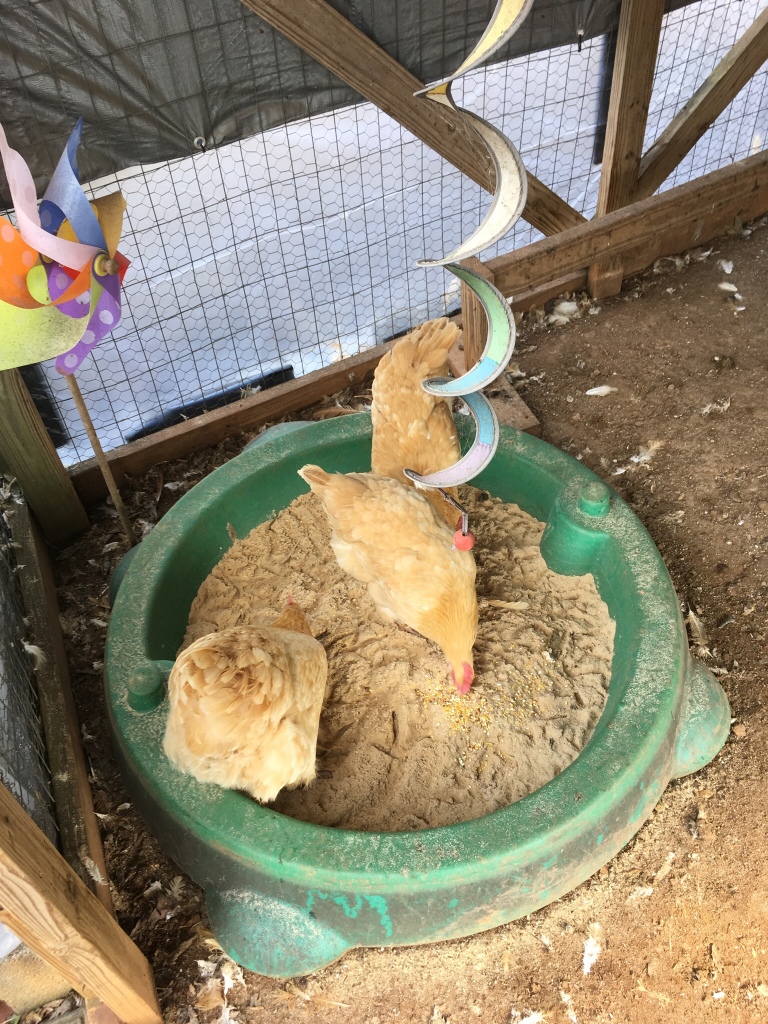
The Kuntry Klucker Crew enjoying digging in a sand box of scratch duirng bird flu lockdown.

Once on lockdown, the flock will generally have to stay in this state till the treat passes. Depending on the month (spring vs fall) it could be longer or shorter. In 2016 when bird flu was detected just two counties away, my flock was on lockdown for about a month before it was safe to allow them to free range again.

White Crested Polish and Silkie crew on lockdown.

I have only needed to put my flock on lockdown once, this was the year when the bird flu wreaked havoc in the United States sparking an egg shortage. Our little farm was only two counties away from the commercial farms that were affected. Although tense, I didn’t panic. I worked to the extent of my limits to protect my flock, after that it’s up to fate.

TARDIS crew digging in the sand for scratch during lockdown.

My flock has bird flu. What do I do?

However, if the worst-case scenario does occur and my flock is affected by bird flu, I ready myself for what I call my “Code Red Action Plan.”

If you suspect that your flock has contracted bird flu, a keeper needs to act fast. Bird flu is very easy to identify in a flock. The affected birds will become lifeless, the combs will be purple, and death will occur very fast (24 hours or less; multiple birds may die at once). If you have any birds that exhibit these signs, your flock has bird flu, and as a keeper, you have only hours to react.

Bird flu will not only wipe out your flock in a matter of days, but depending on the strain, those close to the affected birds can become affected. Some Bird flu strains are zoonotic and thus humans can contract it from their birds, although this is rare, it’s worth knowing. The main impact will be the quick depopulation of your birds due to deaths from the virus.

The first thing a keeper should do if they suspect their flock has bird flu is to call the USDA or their State Veterinarian. These numbers can be easily found via Google search. Once you have alerted them to the condition of your flock, an inspector will be dispatched to your farm to test your birds.

If bird flu is positive, you will be contacted by a federal agent to assist you in managing bird flu in your flock. Should a large quantity of your bird be affected or deceased in most cases they will reimburse you for your lost birds.

Some may wonder if you have to report bird flu in your flock. The answer is YES!!! A keeper is legally obligated to report suspected bird flu cases in their flock. Failure to do so is considered a crime and a keeper could be prosecuted, so yes, you have to report your flock’s condition. The good news is, if your birds all perish, most states will reimburse the keeper for their lost birds.

In some states, inspectors may be dispatched to test flocks within a certain distance of a known case. For example, currently in Indiana bird flu has been reported and dramatically affected several commercial farms. Several of my fellow feathered friend keepers were shocked to have an inspector knock on their door to inspect their flocks. In some cases, this will happen, and keepers are stunned to have inspectors show up at their door to inspect birds. All my friends affected had clean bills of health for their flocks which was a huge relief. But yes, depending on the state and the outbreak reported, this can happen.

What I am doing now? Currently, bird flu is within two states in my location. My birds are still free ranging in the backyard while I pay attention to the reports. Right now, I’m relaxed, not putting too much energy or concern into the situation. I have upped my biosecurity measures and am not allowing any visitors to my flock or adopting new birds. Other than that, it’s business as usual.

However, if reports of bird flu are found in my state of Tennessee, I will then pay closer attention. I will concern myself with the proximity and the rate of affection and prepare to put my flock on lockdown. The girls and I have been through this before, I’m sure we’ll do it again.

I respect the pathogen that causes bird flu, but I don’t panic over it. Typically, small backyard flocks are rarely affected but it can happen here and there. Backyard keepers typically take better care of their birds, living conditions are improved, and most backyard flocks have access to sunshine, a natural environment, and green grass as compared to the commercial flock which often suffer catastrophic bird flu repercussions. All of this helps increase your flock’s immunity, but it’s not full proof. So don’t panic, just have a preparation plan in the back of your mind if needed.

This post was intended to put some perspective into a bird flu scare and equip keepers with measures to protect their backyard flocks. I hope that I have achieved this objective. Bird flu is concerning but keepers don’t need to panic.

As always, thanks for reading. If you have any questions, please leave them in the comments or you can e-mail us a kuntryklucker@gmail.com

I am a published author, multi-disciplinary writer, and blog contributor. If you like this blog, please visit some of my other sites.

Knowledge of the Spheres – Exploring the Celestial Spheres!

Coffee and Coelophysis – A blog about Dinosaurs!

Chicken Math University – Adventures in Homeschooling.

If you enjoyed this post, please peck the subscribe button. Till next time, keep on crowing!

~ The Kuntry Klucker Crew ~

Mites and Lice in Backyard Chickens.

Old man winter has finally made his appearance, temperatures fall, snow covers the ground, a perfect storm for mites and lice to plague a backyard flock.

It’s no coincidence that mites and lice thrive in these conditions. During winter and early spring, mites and lice become a problem area for many backyard chicken keepers. Your once beautiful flock now has messy feathers, pale combs, and dirty bottoms. What is a keeper to do?

First, do not fear mites and lice, they are a natural part of a backyard chickens’ life and a badge of honor. If your chickens have mites and lice, it is proof that they are living the good life. Chickens that have access to the outdoors, grass, sunshine, and fresh air will most likely come down with a case of mites and lice at some point in their lives.

Mites and lice live in the environment. Typically contracted from wild birds, they can also be contracted through small mammals like mice, rats, moles, or rabbits. There is no way to avoid mites/lice in your flock, a control method is the best treatment.

When I first started keeping chickens 11 years ago, I feared the dreaded mite and lice season. I was afraid that I would catch the mites from my birds or that I would not know how to handle the situation.

First, let me put one fear to rest. The mites and lice that plague birds are not the same mites and lice that plague humans. The mites/lice that affect birds are species specific. They cannot thrive on our bodies for several reasons.

1. We do not have feathers.

Mites and lice that affect birds need feathers to sustain their lifecycle. Our daily routines of bathing, washing our cloths and hair make it impossible for these mites to exist on our bodies for long. If your birds have a severe mite/lice outbreak the little beasties may crawl on you giving you a case of the Heebie Jeeves, but I assure you, a simple change of clothes and a shower will render them gone. They are a mind over matter situation.

2. We do not provide them with the necessary resources to carry on their lifecycle.

Avian mites/lice need a specific environment to sustain their life cycle. Denied their breeding environment (i.e., feathers), avian mites/lice cannot survive on our bodies, thus you will not be affected by them. To my knowledge, Northern Fowl Mites (the most common mite that affects chickens) are not zoonotic (carries pathogens, from one species to another). Meaning that humans cannot acquire any diseases from the mites/lice that affect our flocks. We just get a case of the creepy crawlies, that’s about it.

Mites and lice usually reside near the vent area on chickens except crested breeds. Mites and Lice can also be found on the heads of crested breeds in addition to the vent area.

How do identify Mites/Lice on your birds.

Mites and lice prefer these areas for several reasons.

1. It is warm with ample blood supply

2. The birds are unable to preen these areas, thus the mites and lice can accomplish their life cycles uninterrupted.

On birds, mites will look like small little red, black, or brown spots that are moving on the skin. If your bird has a severe case of mites, it may just look like a mass of dark dirt covering their skin. These are Northern Fowl Mites, the most common mite that affects chickens. Left untreated, an army of these little beasties can kill a bird through blood loss (their food) which will cause anemia in the birds. Thus, if not addressed, death.

Lice

Lice on birds are usually found in the same place as the mites. The vent areas and head of crested breeds.

Unlike mites, lice will exist only on the feathers. A cluster of lice eggs will look like a mass of debris that is congrated at the quill of the feather as it meets the skin.

Like the mites, a keeper will be able to see the adult lice crawl on the feathers. Lice are usually sand to light brown color depending on the species.

Both mites/lice will cause a bird to look lethargic, have a pale comb, and a dirty bottom. Lice will add the additional signature of unkept feathers that appear broken, ratty, or disheveled. Both mites and lice will weaken a bird making them more susceptible to illness and in worst cases, death.

How to handle mites/lice in chickens:

There are several ways to approach mites/lice in a backyard chicken flock. Several products are available that address these situations in your birds. I will detail several that I have used in the past along with my methods of application. Disclaimer, these are strategies that I use that have proven successful for me. Please note that I am not a veterinary scientist just a fellow backyard keeper that has been around the block a time or two.

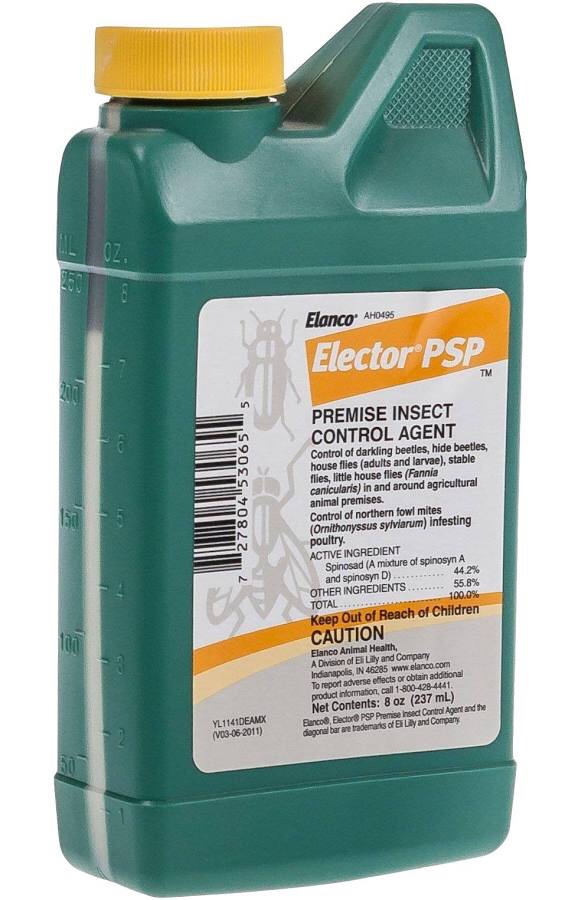
The go-to in my mite/lice arsenal is Elector PSP. This product is in liquid form that is diluted in a spray bottle and sprayed directly on the birds. Due to legislation in some areas, it can be hard to obtain and carries an MSRP of $150 or so if you can find it. Unfortunately, it is usually not carried in most farm/feed stores. I have ordered it in the past from Amazon but as of late they no longer carry it. Due to many of the supply chain disruptions caused by COVID-19, I have been unable to replace the supply that I bought nearly 7 years ago. Hopefully, it will become available soon.

Elector PSP pro.— The pro of Elector PSP is that it kills on contact and brings the mite/lice situation to an abrupt end. It does need to be reapplied 10-14 days after the first application to kill any eggs that hatch. No egg withdrawal is required when using this product. In addition to spraying, it directly on the birds, I will also spray the inside of the coops and nesting boxes to rid the environment of the little beasties. I have had very good results with Elector PSP.

Electro Cons.—The con of Elector PSP is price and availability.

My second go-to in my mite/lice arsenal is Eprinex. As with Electors PCP, this product is in liquid form and is applied directly to the skin. However, unlike Elector, Eprinex has an egg withdrawal of 14 days after each application. Eprinex is applied in the same manner as flea and tick treatment for cats and dogs. Apply Eprinex directly to the skin behind the head of your birds. I will also apply a drop on top of the head for my crested breeds, such as the Polish and Silkie. These breeds often experience mites/lice on top of their heads due to their inability to preen this area. In 14 days, reapply to address any mites that hatched after the first application.

Eprinex application directions

Using a syringe with the needle removed, apply 3/4 cc for standard-size breeds, for bantam breeds, apply 1/2 cc directly to the skin behind the neck. Although designed for cattle, Eprinex is safe for use on chickens in small amounts.

Eprinex works by absorbing into the oil of the skin. When the mites and lice bite the birds, they encounter the Eprinex and are killed. After the first application, reapply in 14 days. Egg withdrawal should be observed for 14 days after application. This means that from start to finish, mandatory egg withdrawal should be observed for 28-30 days.

Eprinex is available at most farm/feed stores and carries an MSRP of around $50. The only con with Eprinex is a mandatory egg withdrawal. I have a large flock, so I will apply Eprinex to one breed at a time, reducing the effects of egg withdrawal. I have used Eprinex for many years with great success.

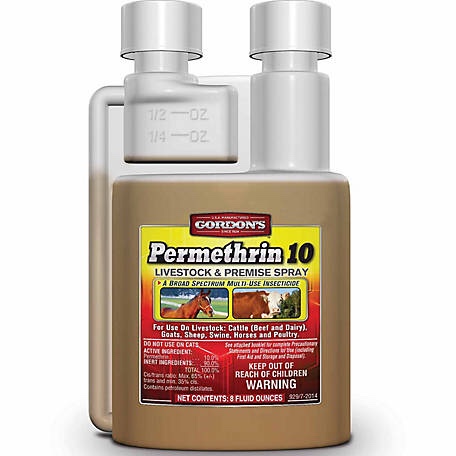
Permethrin-10

As with Elector PSP, when treating your flock for mites you will also need to treat the coops. When using Eprinex, I will mix a solution of Permethrin 10 livestock spray and spray my coops and nesting boxes. This combined with Eprinex will bring the mite/lice situation to an abrupt halt.

Additional methods.

During the winter months, I will supply my flocks with a sandbox containing a mixture of sand and peat moss. My girls will readily use this for dustbathing while the ground is snow-covered or wet. This allows them to maintain their natural behaviors that aid in mite and lice prevention.

As you can see, mites, while a very common occurrence in backyard flocks is very easy to address and treat. While they can be a pain to deal with, remember that your girls are living the good life if they come down with a case of the little beastie. Your girls have access to fresh air, sunshine, grass, and nature, something that many chickens are denied.

I hope this post help put the dreaded mites and lice season in their perspective place. They are nothing to fear and are very easily treated with multiple products available.

To watch a video on treating chickens for mites and lice chick here.

I am a published author, multi-disciplinary writer, and blog contributor. If you enjoyed this blog, please visit some of my other sites.

Coffee and Coelophysis – A blog about Dinosaurs!

Chicken Math University – Adventures in Homeschooling

If you liked this post, please peck the subscribe button. As always, thanks for reading. Till next time, keep on crowing.

We’re on Facebook! Drop by and say hi. We’re always happy to see new folks and show you around the “coop-hood”.

~ The Kuntry Klucker Crew ~

Introducing New Chicks to An Established Flock.

As late summer is coming to an end, and spring chicks are now full-grown birds, it’s time to introduce them to an established flock.

I like many backyard chicken keepers, acquired new chicks earlier this spring, and am now in the process of introducing them to my established flock. While this process is rather easy, it takes time and must be approached with care.

It is in a chicken’s nature to resist any new members to the flock, if done too hastily, it could spell disaster or death for the new kids in the flock. In this post, I will explain why chickens are resistant to new members and how to introduce them so that this process is done successfully.

Why do chickens resist new members?

To understand why chickens are so resistant to new members, we need to get into the head of a chicken using a bit of chicken psychology.

Chickens are highly socially organized creatures. Their entire lives revolve around a hierarchy. Within this hierarchy, each member knows their place and what this assignment means in terms of flock activity.

Typically, the flock hierarchy begins with the alpha rooster, under him will be any subjugated roosters in the flock, these boys will then assume the beta rooster positions. Following the roosters will start the order of the hens. The head hen or alpha hen will occupy the top position in the order. The Alpha hen is a bit bossy regarding the other hens in the flock. She is the individual who will often roost next to the roosters at night and is commonly the “favorite” of the alpha rooster in terms of mating. This may be due to her size, receptiveness to mating, or her fertility as judged by the roosters.

Occupying the hierarchical positions under the alpha hen will be the other hens in the flock. Order and status are determined by the “pecking order”. Members in a flock peck each other on the back indicating status. The pecker is above the pecked in flock hierarchy. This competition for position flows from the alpha rooster down to the member that is at the bottom of the pecking order.

Once established, the order is strictly maintained. Any breach of the position will be met with a firm reminder of this order and each place within it. Once in a while, a member may challenge and higher hierarchy order individual for their position. This is usually met with a skirmish which will decide if the challenger successfully raised their position or is put in their place. This behavior is not just found among the roosters in the flock, hens will also fight for position and status in the flock.

Once the flock agrees on the order, all activities within the flock revolve around this order. Everything from who roosts where, to the order in which they exit the coop in the morning, and the order in which they return at night are all determined by the pecking order. The alpha hens will often eat from the feeder first in the morning. After she gets their fill, the other hens will then get their share. The roosters most commonly eat last despite their hierarchical position in the flock. It is by evolutionary design, that the roosters know that the hens need the nutrition for flock procreation. A good rooster will always let the hens eat first, he will then eat any remaining morsels.

As organized and structured that the flock hierarchy may be, it is fluid, and always in flux. Many activities can affect the pecking order in a flock. Events such as an illness or death of a member. If a member is injured and can no longer defend their position, they will oftentimes find themselves at the bottom of the pecking order. Once they recover, they can sometimes regain their previous position, although this is not guaranteed. In the case of the death of an individual, the hierarchy reorganization can be quite sophisticated.

For example, when we lost our rooster, Roy, the flock found themselves suddenly without their top member, the Alpha member. It took the girls a while to decide who was going to occupy the position at the top of the pecking order. After the decision was made, the rest of the girls had to reestablish their position in the flock. It took several weeks for the girls to finally agree on the new pecking order. Once it was established, peace reigned once more in the coop.

It is for this reason that chickens are so resistant to any new additions to the flock. When a keeper introduces new members to the flock, they interfere with this sophisticated hierarchical social construct within the flock. Knowing this, a keeper needs to take care of how and when to introduce new individuals to an established flock.

There are several things that a keeper can do to make this transition as least stressful on the flock as possible. I will dedicate the rest of this post to the process I have used for over a decade of chicken keeping.

Brood new chicks in the flock environment or close to their enclosure.

If using a broody hen to hatch and rise a clutch of chicks for you, she will take care of the introduction of her new chicks to the flock. In the absence of a broody hen, it falls on the keeper to make this social transition. The easiest way to do this is to brood the chicks in the pen if possible, or near the established flock’s habit.

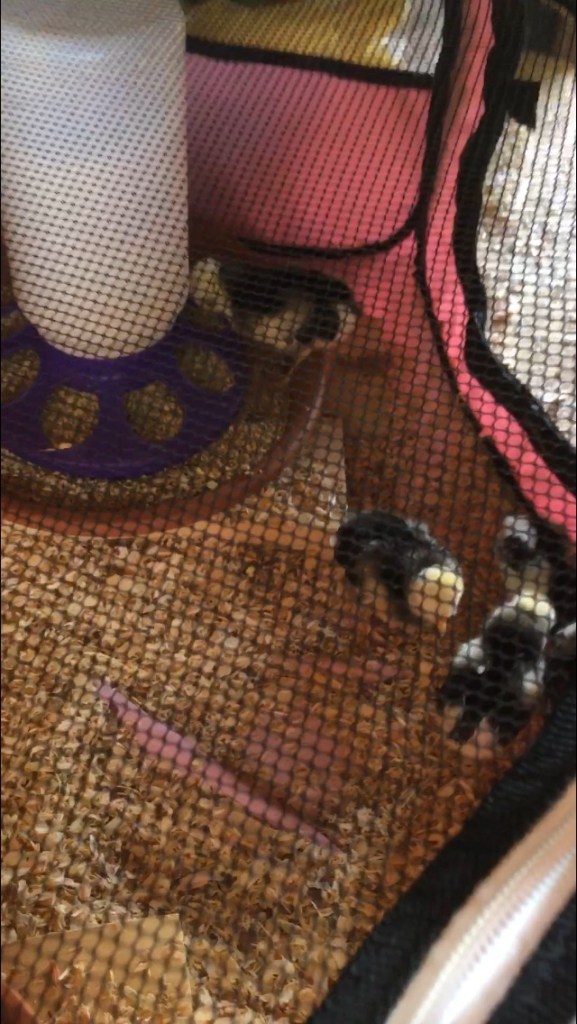
When I get a new clutch of chicks, I will keep them inside for the first two weeks. This allows me to monitor them so for health issues, physical issues, or other behavioral issues. Once I am confident that they survived their trip and have acclimated to the brooder environment, I move them outside to the girl’s pen.

Inside The Kuntry Klucker, I have a wood pot shelf that I will set the brooder on. The girls are unable to gain any access to the chicks but are aware of their presence and activity. This does several things; this allows the established flock to get to know the new kids in the flock early on. Over time they will become accustomed to their presence in their environment, they will begin to ignore them and just associate them with the daily hum of flock activity.

Once the chicks are large enough to run in the pen, I will take them out of the brooder, and give them access to the larger pen environment. During the phases, I will cut off the girl’s access to the pen from the coop and will open the external access door on the side. The established flock will then exit and enter through this secondary external access door. Meanwhile, the chicks will be confined to the indoor pen. This allows the established flock to see and interact with the chicks while forbidding any contact.

As the chicks grow, the established flock will be allowed visual access only. Over time, the established flock will once again ignore the presence of the chicks, as they become a daily presence in their lives.

Once the chicks are roughly the same size as the established flock, around 18-20 weeks, I will then, allow the established flock access once again to the indoor pen area where the chicks have spent the last several months. By this time, the chicks have reached egg-laying age and are put on the same layer of feed that the established flock normally consumes.

By this time, the established flock is so used to the chicks being present in their lives and environment. Thus, the transition is much easier on both flocks.

This method works best if you are introducing a group of new individuals to your established block. I try to introduce groups of at least 5 or more. This year I am introducing 12 new individuals to my flocks. The larger the new flock the better.

The Pecking Order Begins:

Once the two flocks are allowed to contact each other, the new pecking order begins. The established flock will begin pecking the new flock members on the back, indicating they are at the bottom of the pecking order. It is for this reason that the new kids in the flock need to be roughly the same size as the established birds. This allows them to handle the pecking order initiation process much better.

The pecking order at first may seem brutal. The established flock is putting in its two cents on the new hierarchical assignments. As long as it is just pecking on the back, I do not intervene. If the pecking order takes on more of a harsher bullying quality, I will then monitor the pecking order assignments for several days till the flock seems to agree on positions.

The initiation process usually recedes in a few days. At most, my flock wrestles with the pecking order decisions for a week. It usually does not take long because the new members generally reside at the bottom of the pecking order. Very rarely do new members challenge established members for a higher position in the flock hierarchy. Even new roosters will often take a subjugated position at the bottom of the pecking order vs challenging the alpha rooster for his position.

Once the flock agrees in the place of the new members, flock harmony reigns once more. For several months there may be a bit of pecking as reminders of position. But for the most part, the hard part is over.

As time goes on, the flock will act more like a single flock rather than two individual flocks. By the 4–6-month mark, the two flocks will work as one. The new members will most likely reside at the bottom of the pecking order for the first year of their lives. After that point, they may try to challenge another member for a higher position, but even this is not usually an issue.

At this point, if you have a rooster in the new flock, they may begin to fight. I have had this go both ways. I have had a new rooster after several months challenge one of the established roosters for their position. I have also had new roosters just sit happily at the bottom of the order. This all depends on the temperament of the new rooster. He may assume the beta position well or he may not. It is during this time that you need a plan for your extra roosters. I typically put my roosters in bachelor pens where they bunk with other roosters. I will link the post here where I detail how bachelor pens work.

Even when roosters compete for the position, the skirmish does not last too long. I have 13 roosters; all are well-behaved and get along fairly well. Once they decide on the social order, they will happily tolerate one another.

I hope this has helped many fellow “spring chicken” backyard chicken enthusiasts merge new chicks into an established flock.

Chickens are very simple creatures; one just needs an understanding of their nature and habits. They ask little but give much in return.

If you still have questions, please feel free to leave me a comment or contact me at kuntryklucker@gmail.com.

I am a published author, multi-disciplinary writer, and blog contributor. If you enjoy this blog, please visit some of my other sites.

Coffee and Coelophysis – A blog about Dinosaurs!

Knowledge of the Spheres – Exploring the Celestial Spheres!

Chicken Math University – Adventures in Homeschooling.

If you enjoyed this post, please peck the subscribe button. As always, thanks for reading! Till next time, keep on crowing.

~ The Kuntry Klucker Crew ~

What to Know Before You Get Chickens.

The girls spending the evening grazing on a freshly cut lawn.

Know your Zoning laws:

First and foremost, before you get chickens, know your zoning restrictions. Many cities, states, and counties have different laws regarding keeping livestock. If you are in the city, if you are allowed backyard chickens, you will most likely be restricted to a small number of hens, omitting roosters.

In the county or country, you may have more freedom, but you will still need to abide by guidelines.

For example, based on my location, I am not restricted to the number of chickens I can have. However, I am restricted on how far my coops need to be from my neighbor’s front door. My animals must be confined to my property by a fence or attached pen to a coop. I need to practice good manure management to reduce rodent and odor issues for my neighbors. Even in the country, some guidelines need to be followed.

Caster making his way out of the Coop De Ville to the outdoor pen area.

If you are unsure of what your zoning laws require, you can find out simply by calling the State Veterinarian for your state and asking. They will be able to tell you based on your location what your restrictions are.

Addiction

As the saying goes, “You can’t have just one”. This more than applies to owning chickens. I started with 17 Buff Orpington chicks and now have ballooned to a flock of 50+ of various breeds. I underestimated the addiction risk of chickens. I love my backyard divas and have plans for more.

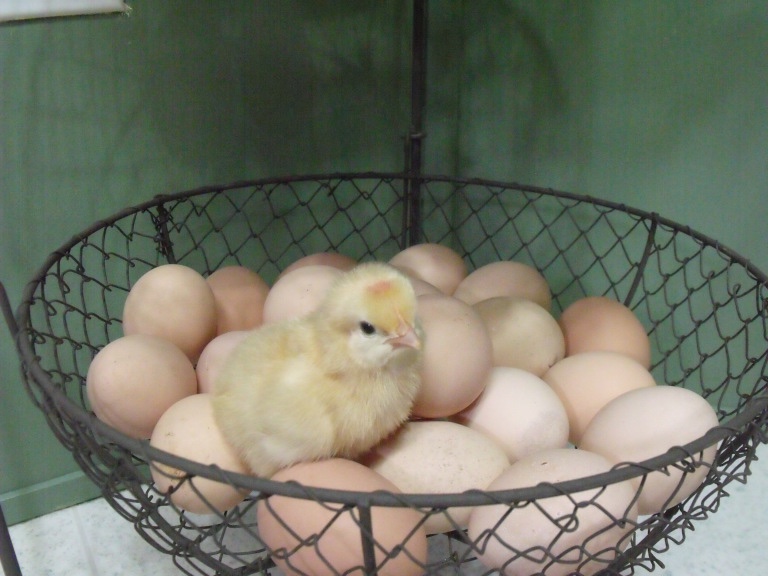
Buff Orpington Chick sitting amongst farm fresh eggs.

Today my flock is a thriving multicultural mesh of different breeds. By acquiring a variety of breeds, I can profile the behavior of various breeds along with any advantages and drawbacks. After owning several breeds, I can honestly say that the Polish are my favorite breed of all my Backyard Divas.

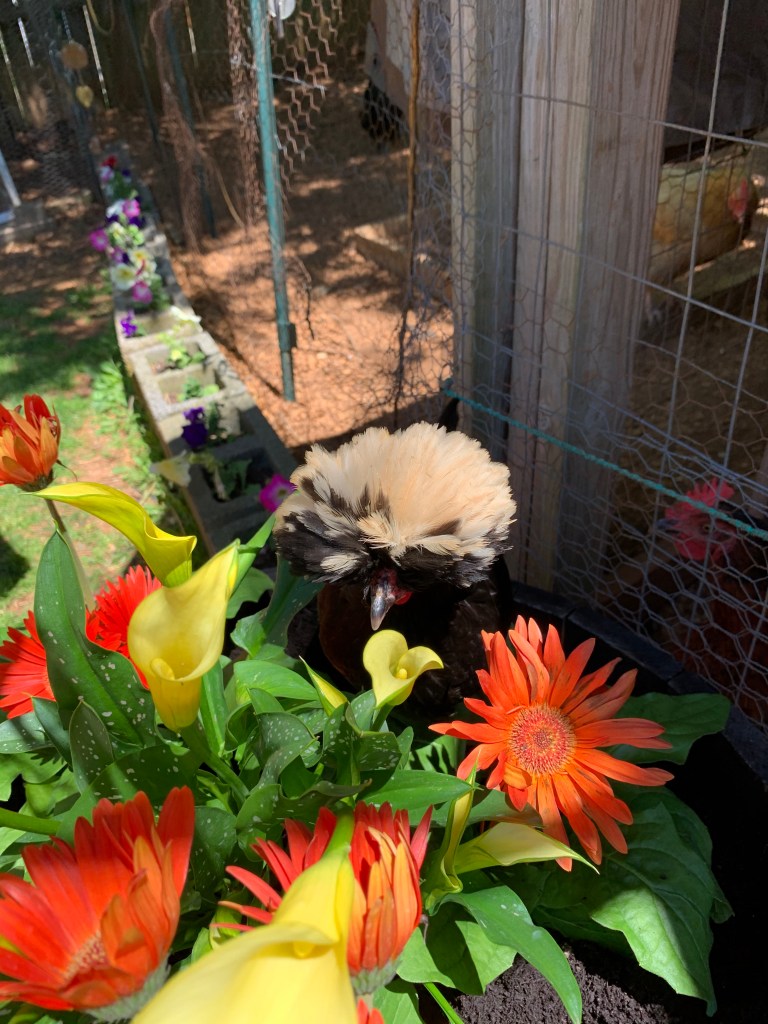
Aphrodite in a barrel of Gerbera Daisies.

Time/chores

Clean coops and happy hens after morning chores.

Chickens require time and daily care. Like all pets, chickens require dedication. However, chickens require little but give much in return.

To illustrate. My flock of 50 and 7 coops requires about 30 minutes of my time every morning. Daily chores consist of cleaning the coops, filling feeders, filling waterers, collecting eggs, and maintaining nesting boxes. All of this, while sounding like a lot does not require much time out of my day.

However, like a dog or cat, maintenance needs to be performed daily. Also, like your cat or dog, if you go on vacation, care will need to be arranged in your absences.

Eggs

Tripple tier egg storage basket in my kitchen.

Most people keep chickens for farm fresh eggs. However, this pursuit, although positive has some drawbacks.

First, once you get a taste of farm fresh eggs, it’s hard to eat any other type of egg. For example, store-bought eggs after eating farm-fresh eggs taste differently. You will find yourself becoming an egg connoisseur of sorts, an egg snob if you will.

Basket full of eggs. The girls were busy today.

Second, you will come to realize that at first, your flock will produce the most expensive eggs that you ever collected. Allow me to explain.

Once obtaining your flock, it will be about 20 weeks or 5-6 months before you collect the first egg from the nesting box. But during the “waiting period”, you will have to feed your flock. Egg laying or not, feeding your flock is a necessity. By the time you get your first egg, you will have spent a hefty amount on chicken feed, flock supplies, and coops/pens. However, once the flock starts to lay dependably, your cost and reward ratio will begin to align. But until then, you will be putting money into a “timeshare” of sorts without any benefit. Many people do not realize this, they falsely assume that chickens lay eggs right away and do not factor in a period of egg drought.

Egg droughts do not only happen during the development/maturity of the hens toward laying age but also at various times throughout their lives. Yearly molt, the coldest part of winter, or the hottest part of summer depending on the breed. The point is, your flock will go through dry spells where they are not laying but you will be spending money on chicken feed. During these times of declined egg production, I humorously refer to my girls as “free-loaders”. All in good spirits of course. I understand my girls need a vacation now and then and grant them time off.

Premium chicken feed the girls earned with the sale of their eggs. My flock is a big fan of Purina chicken Feed. They prefer it to any other brand. My girls are indeed pampered poultry.

Third, they will find you. When an egg recall or egg ration is suffered by the egg industry, backyard chicken keepers become everyone’s favorite neighbor.

Empty egg coolers at my local Walmart during the past bird flu scare and massive egg recall. And just like that the crazy chicken lady is everyone’s favorite neighbor.

For example, during the past egg scare when the bird flu raged havoc throughout the egg industry, I got a few unexpected visitors at my door. It takes quite a bit of gut to knock on a stranger’s door and ask for eggs.

The situation of this particular visitor was rather unique. She was a friend of a friend, who worked with a friend who told her that she knew me and that I had a fairly large backyard chicken flock. Her husband was on a strict diet, eggs were his primary source of protein. Being that the bird flu forced many egg producers to recall eggs and euthanize their flocks, he was practically starving.

I gave her what eggs I had. I offered them at no charge given their unique and desperate situation. She insisted that she pay for them. This was the first day that a stranger knocked at my door and the girls turned a profit, but it was not the last.

All proceeds the girls make on the eggs, I turn back to them in the form of feed, treats, and other necessities.

This was when I first realized how self-sustaining my little farm is. A massive egg recall raging through the nation, had I not watched the news, I would have had no idea. Now, when egg recalls or egg scares make the news, I am prepared for a few visitors looking for eggs. The humble backyard chicken keeper to the rescue.

Illness and the importance of a Chicken first aid kit:

First Aid Kit for my girls.

Just like kids and other pets, chickens too get sick. However, unlike a pediatrician for little humans and vets for cats and dogs, most vets will not treat chickens since they are technical “livestock”. While backyard flocks are rapidly reaching pet status, for now, they are categorized as livestock.

Thus, the backyard chicken keeper has to become a chicken doctor. Although this sounds scary, chickens are simple creatures. Most conditions that plague a backyard flock are relatively simple to treat.

The more common health conditions that a backyard chicken keeper will encounter are mites, lice, bumblefoot, fly strikes, respitorary illnesses, and sour crops. The good news is good flock maintenance practices will eliminate many of these conditions. If your flock has fresh water daily, fresh feed in clean feeders and a clean dry place to call home, most of these potential illnesses will be greatly reduced.

In my 10 years of keeping chickens, I have only had a few illnesses inflicted my flock. Mostly treatment for mites, worms, and bumblefoot. If your chickens are allowed to free range, at some point they will come down with a case of red fowl mites. You can think of mites as a badge of honor because your flock has access to grass, fresh air, and sun. Treatment is similar to flea/tick treatment for cats and dogs only for chickens. My favorite product for this purpose is Epernix. Found a Feed/Farm store in the cattle section.

Marketed for cattle, Epernix at a low dose is safe for chickens. Use 1/2 cc for bantams and 3/4 cc for standard-size birds. With a syringe, drop the liquid behind the neck, just like treating a cat or dog. Repeat in 14 days, and that’s it. After two doses, lice and mites are history. Treat every single flock member, I do this 1 to 2 times a year. I treat only when symptoms are present. Note: when using this product there is an automatic egg withdrawal of 20 days while the girls are in treatment.

Worming is the same. Marketed for goats, safeguard at small doses it is an effective treatment for chickens. This time, with a different syringe use 1/2cc for bantam and 3/4cc for standard-size birds. Drop the wormer on a piece of bread and feed it to each member of the flock, repeat in 14 days. There is a 20-day egg withdrawal for safeguards like Eprinex. That’s it, crises averted.

The most complex issue I have had to deal with is bumblefoot. I will link a post detailing my method for dealing with bumblefoot here.

Although chicken keeper needs to take their flock’s health into their own hands, it’s not hard. Most things you need to treat your flocks are found at feed/Farm stores. If you can find a vet to treat your birds, the price will be very high. However, most vets will put a gravely ill chicken down. Some keepers prefer this to put their sick hens down. I humanly euthanize my sick members, but most people are not able to do this which is fine. Most vets will assist in this event.

Chicken first aid kit.

Things to keep in your chicken first aid kit:

Vet wrap, gauze, triple antibiotic cream, salve, plastic knives for administrating salve and creams, sterile scissors for cutting gauze and vet wrap, hydrogen peroxide, syringes without needles for administrating medication orally, Rooster Booster poultry cell (great for providing sick birds with iron, amino acids, and minerals for recovery), Rooster Booster B-12 (good for providing sick birds with essential vitamins for healing, high in B-12), VetRx for poultry (great for birds with respiratory issues, similar to Vicks for humans. Drop in water or place under the wing to help birds recover), bleach to sterilize instruments.

Most of these things are household items except for items specific to poultry. Keeping a first-egg kit (pun intended) ready and stocked makes it easier to treat on the spot rather than waiting till you can get the items you need.

Have a plan for winter

When acquiring chickens, most people are so focused on brooders and bringing their flock to laying age. Little thought is given to seasonal change. As fall approaches keepers often find themselves frantic as the mercury drops. Preparing a flock for winter takes time, preparation, and some expense. However, chickens come factory installed with down coats, it’s not the cold keepers need to worry about but wind and moisture. To adequately prepare your flock for winter a keeper needs to take measures to keep the coop/pen clean and dry. Installing a heater or heat lamp is not recommended. Coop fires are often started by good intentions to keep flocks warm. The rule of thumb is to never judge your flock’s comfort by your standards. Chickens evolved to live outdoors, all a keeper needs to do is keep them clean and dry, warmth is not necessary, the chickens take care of that on their own. I will link here the methods I use to prepare my flock and coops for winter.

Coops and Pens: There are so many options.

Before you get chickens, decide what kind of coop you want to get. Before shopping for coops, you need to know how many chickens you intend to get and how many coops you want to have. There are lots of resources for acquiring coops. If you are skilled at woodworking, you could build your own coop and pen. If you’re like me and woodworking is not your cup of tea, there are many prefab coops on the market. Contrary to popular belief, prefab coops can and do make great homes for your flock. I will link here my post where I talk about prefab coops, hacks, and how to get the most out of your prefab coops.

Finally and most importantly: Brooder set up

To raise a successful flock, your chicks need a good start, and the best place to get this start is in the brooder. Before you get chicks, you need to think about their brooder and how you plan to brood your clutch. Just about everything you can think of has been used for brooders, kiddie pools, Rubbermaid totes, dog crates, boxes, bathtubs, garages, attics, and so on. The possibilities are endless. At the end of the day, a brooder is just a heated home for your growing chicks, what you use to achieve this home is up to you. I started out using large boxes then switched to puppy playpens as my preferred brooding container. Everyone will have their idea on what to use and how to brood. The size of the flock will also affect the type of container to use. I will link my brooding method and supplies here.

Grape Arbor and the Coop-Hood.

I hope that this post has been a helpful addition to the information-gathering phase on starting your backyard chicken flock. Chickens are a great asset to any farm, homestead, or city backyard. They ask little but give much in return.

If you have any questions not addressed in this post, feel free to ask. You can also drop us a line at kuntryklucker@gmail.com

I am a published author, multi-disciplinary writer, and blog contributor. If you enjoy this blog, please visit some of my other sites.

Knowledge of the Spheres – Exploring the Celestial Spheres’!

Coffee and Coelophysis – A blog about Dinosaurs!

Chicken Math University – Adventures in Homeschooling.

If you enjoyed this post, please peck the subscribe button. As always, thanks for reading. Till next time, keep on crowing!

~The Kuntry Klucker Crew~